Skip to content
yodeck digital signage
  • FAQ
  • Support Center
  • Contact
  • Home
  • Getting Started
    • Logging into the Yodeck Portal and creating an account
    • Portal Overview
      • Overview of the Yodeck Portal
      • Pushing Changes to Screens
      • Help Icons
    • Creating a Yodeck Player
      • Creating a Yodeck Player based on Raspberry Pi 4
        • Creating a Yodeck Player based on Raspberry Pi 4 - Introduction
        • Downloading and using Etcher
        • Yodeck Raspberry Pi Compatibility Chart
        • Raspberry Pi Comparison
        • What is the Yodeck Player?
        • Notes for the Raspberry Pi 4
        • Connect the Yodeck Player to a WiFi using your mobile phone by scanning a QR code
      • Creating a Yodeck Player based on Raspberry Pi 5
        • Creating a Yodeck Player based on Raspberry Pi 5 - Introduction
        • Raspberry Pi 5 Limitations
      • Creating a Yodeck Player based on Chrome browser
        • Setting up a Yodeck Web Player
        • Comparison Table RPi vs Web player
        • Web Player Chrome Extension and PWA
      • Create a Yodeck Android Player
        • Setting up an Android player with the Yodeck Software (via APK)
          • Setting up an Android player with the Yodeck Software (via APK--Android 7 or earlier)
          • Install Yodeck in Android with the Windows and Linux Setup Helpers
          • Install Yodeck in Android with Setup Helper
          • Setting Up Remote Device Management (RDM) on a Sony Bravia Professional Display with the Yodeck Android (APK)
          • Setting Up Remote Device Management (RDM) on a Sharp ME Display with the Yodeck Android (APK)
        • Creating a Yodeck player based on Android
          • Setting up an Android player with the Yodeck Software (from Play Store)
          • Tested and Approved Android Devices
          • Android Limitations
        • Create a Yodeck Android Player - Introduction
      • Create a Yodeck Amazon Player
        • Creating a Yodeck Player based on Amazon FireOS TV/Stick
          • Amazon FireOS Limitations
          • Setting up a Yodeck Amazon Signage Stick Player
        • Create a Yodeck Amazon Player - Introduction
        • Setting up a Yodeck Amazon FireOS Player
      • Creating a Yodeck Player based on Brightsign
        • Setting up a Brightsign player with the Yodeck Software
        • Comparison Table Raspberry Pi vs Brightsign player
        • Supported Brightsign Players
      • Creating a Yodeck Player based on Tizen
        • Samsung SSSP / Tizen Supported Devices
        • Tizen Limitations
        • Update the firmware version on your Samsung Tizen TV
        • Setting up a Tizen player with the Yodeck Software
      • Creating a Yodeck Player based on webOS
        • Setting up an LG webOS player with the Yodeck Software
        • LG webOS Supported Devices
        • LG webOS Limitations
      • Creating a Yodeck Player based on Windows
        • Setting up a Windows player with the Yodeck Software
        • Installation Guide of WMIC Utility for Windows 11
        • How to uninstall the Windows application
        • Windows Supported Devices
        • Set Up the Yodeck Windows Player
      • Creating a Yodeck Player based on ChromeOS
        • Setting up a Yodeck ChromeOS Player
        • ChromeOS Limitations
      • Creating a Yodeck Player - Introduction
    • Getting Started FAQs
  • Navigating the Platform
    • Main Menu Overview
    • Dashboard Overview
    • The Dashboard
  • Media & Apps Management
    • Media Overview
      • Supported File Extensions
    • Media Library
      • Images
        • Gallery
        • Images Introduction
      • Videos
        • How to create a simple Video-wall with Yodeck
        • How to setup an HDMI video feed input or connect a USB camera (Video Input)
        • Recommended USB devices
        • Videos Introduction
      • Web Pages
        • Web Scripting Engine & Webpage Recording Tool
          • Web Scripting Engine
            • Scripting Engine Reference
            • Scripting FAQ
            • Scripting Templates
            • Tutorial - Google Analytics
            • Tutorial - How to remove the cookie pop-up from your web page media
            • Useful Scripts To Use
            • Mask your credentials at the Scripting Engine text field
          • Hide Cookie Banner - Script Automation (BETA) 
          • Webpage Recording Tool
        • Web Pages Introduction
      • Audio Assets
      • Documents
    • Media Management FAQs
    • Apps
      • Weather Apps
        • Current Weather
        • Daily Weather
        • Hourly Weather
        • Weather Radar
        • Weather Wall
      • Time Apps
        • Analog Clock
        • Counter Down
        • Counter Up
        • Date & Time
        • Word Clock
        • World Clock
      • General Apps
        • Interactive Kiosk
          • Custom Keyboard Guide for Interactivity
          • Interactive Kiosk - Introduction
        • World Football Feed 2026
        • Bonusly
        • Custom Feed
        • Daily Feed
        • BambooHR
        • Ticker
        • Google Slides
        • DSMenu
        • TV Source
        • Teams Celebrations
        • Google Sheets
        • WiFi Share
        • Embed
        • Player Basic Info
        • Google Traffic
        • Waze
        • Birthday Notification
        • PosterMyWall
        • WikiQuotes
        • QR Code
        • Online Slideshow
        • Rich Text
      • News Apps
        • Al-Jazeera RSS
        • Bloomberg News
        • BBC RSS
        • CBC RSS
        • CNN RSS
        • CTV News
        • ESPN RSS
        • Fox News
        • Google Alerts
        • Google News RSS
        • NU.nl News RSS
        • SharePoint News
        • Sky News RSS
        • The Guardian RSS
        • The New York Times
        • The Wall Street Journal
        • Custom RSS
      • Social Apps
        • Facebook
        • Instagram
        • LinkedIn
        • Twitter
        • Taggbox Display
        • Microsoft Teams Town Hall
        • Walls.io
      • Calendar Apps
        • Calendar Apps Introduction
        • Google Calendar
        • Outlook Calendar
        • Daily/Weekly Calendar
        • Monthly Calendar
        • Calendar Events Feed
      • Dashboard Apps
        • Power BI with Service Principal
          • Power BI with Service Principal - Introduction
          • Power BI with Service Principal - Identity Requirements
        • Salesforce
        • Qlik Sense
        • Power BI
        • Google Looker Studio
        • SmartSheet
        • Airtable
        • Tableau JWT
        • Cyfe
        • My Dashboard
        • Asana
        • Tableau
        • Google Analytics
        • Xero
        • Fathom
        • Shedul
        • Trello
        • Zoho
        • Baremetrics
        • Putler
        • ChartMogul
        • Chargebee
        • Zenkit
        • Grafana
        • Display "ServiceNow" Data on Your Screens Using Yodeck’s Grafana App
        • Monday.com
        • Jira
      • Business Tool Apps
        • Microsoft Planner
        • Canva
        • Microsoft Teams Rooms
        • Notion
        • Zoom Rooms
        • Qube
        • SharePoint
        • Teams Channels
        • Viva Engage
      • Interactivity Apps
        • Interactive Kiosk
        • Interactive Library
      • Custom Apps
      • Custom App Developer Guide
        • App Codes & Examples
          • Display Public IP (sample App)
          • The Simple Clock
          • Shedul (sample App)
          • Trello (sample app)
          • Current Weather
          • Digital Clock (sample App)
          • Monthly Calendar
          • Calendar Events Feed
          • Date&Time App Code
          • Daily Weather App Source Code
          • ChartMogul (sample app)
          • Sample Web Widgets
          • Sample HTML Widgets
          • Tutorial - Your 1st Widget
          • Baremetric (sample app)
          • Hourly Weather App Source Code
          • Google Calendar (Sample App)
          • Count Down/Up
          • Rich Text (Sample App)
          • RSS Custom
        • Building an HTML App
          • Analog Clock (sample App)
          • 4. Adding Transparency (Optional)
          • 3. Making the Clock Efficient
          • HTML App API
          • HTML App Packaging
          • Player HTTP API
          • 2. Add Options to the Clock App
          • 5. Zipping and Uploading the Custom Sample Clock
        • Static Apps
        • Custom Apps Introduction
        • UI Form Definition for Custom Apps
        • Building a Web App
      • Add-ons
        • Embeddable Feeds - Add-on
          • Embeddable Feeds
          • Counting Embeddable Feeds' Views
        • Yodeck Assurance
      • App Compatibility Table
      • Apps Introduction
      • Available Apps!
      • ScreenFeed Apps in Yodeck
    • Apps Management FAQs
    • Media Availability
  • Content Management & Scheduling
    • Playlists
      • Dropbox Playlist
        • Dropbox Playlist Introduction
        • Dropbox - OneDrive - SharePoint - Google Drive - Google Photos Supported Media Formats
      • Playlists' FAQs
      • Playlists Introduction
      • How Sub-Playlist Playback Works
      • Managing Playlists with Folder View ON
      • Interactive Playlist
      • Playlist of Layouts
      • Tag-Based Playlist [Premium & Enterprise Plans only]
      • Sub-Playlists [Premium & Enterprise Plans only]
      • Import CSV [Premium & Enterprise Plans only]
      • Google Drive Playlist
      • OneDrive Playlist
      • SharePoint Playlist
    • Layouts
      • Layouts' FAQs
      • Getting Started with the Yodeck Layout Editor
      • Using Templates in the Layout Editor
      • Editing and Customizing Content in the Layout Editor
      • Working with Screen Sizes and Aspect Ratios in the Layout Editor
      • Locking Elements and Controlling Access in the Layout Editor
      • Branded Templates: Create and Manage Reusable Layout Designs
      • Advanced Settings and Scheduling Layouts in the Layout Editor
    • Schedules
      • Schedules' FAQs
      • Schedules Introduction
      • Examples of Schedules
      • Turned Off option - How to Turn your TV On and Off
      • Scheduled Availability
    • Prioritization of Content Types
  • Screen & Device Management
    • Adding & Managing Screens
      • Sound/Display
        • Support for LED board screens and billboards
        • Sound/Display Introduction
      • Network
        • Wireless
          • Configuring your player's WiFi network by editing the SETTINGS.TXT file
          • Configuring your WiFi network using an Ethernet cable
          • Quickly connect your Yodeck player to your WiFi network by using the WiFi wizard
          • Wireless Introduction
        • 3G/4G/LTE
          • Advanced Configuration for 3G / 4G / LTE modems
          • 3G/4G/LTE Introduction
        • Network Introduction
        • Proxy
        • Static IPs
        • Keeping Your Players on Time by Configuring an NTP Server
      • How to Register a Screen in Yodeck
      • Yodeck Registration Code
      • Screen Email Notifications
    • Screens Overview
      • Screens Overview Introduction
      • Understanding Screen Messages in Yodeck
      • Location
      • Status
      • Media Filtering
      • Working Hours
      • Screen Takeover
      • Screens Table Manual
      • Basic Info
    • Assigning Content to Screens
      • How to quickly assign content to your Screens
    • Monitoring Screen Status
    • Advanced Screen Options
      • Customization
        • Custom arguments/policies for Chromium
        • Customization Introduction
        • How to add custom proxy settings per Web Page using the Advanced Player Directives
      • Security
        • Security Introduction
        • Custom Certificates
        • Encrypt Player Storage [Enterprise Plan only]
        • Lock Down Player [Enterprise Plan only]
      • Advanced Screen Options Introduction
      • On-screen Messages
      • Timed Events
    • Interactivity
      • GPIO-Triggered Signage with Yodeck
        • GPIO Demo App: ON/OFF Trigger Example
        • GPIO HTTP API
        • GPIO Technical Documentation
        • Introduction to GPIO-Triggered Signage with Yodeck
      • Interactivity Introduction
    • Screen FAQs
  • User & Account Settings
    • Users & Groups
      • Users
      • Custom Roles
      • Groups
    • Account Settings
      • Emergency Alerts
        • Default Emergency Alert Types
        • Common Alerting Protocol (CAP) Integration
        • National Weather Service Alerts
        • Emergency Alerts Introduction
      • Single Sign-on (SAML 2.0)
        • How to configure SSO with OneLogin
          • How to configure SCIM with OneLogin
        • How to configure SSO with Okta
          • How to configure SCIM with OKTA
        • How to configure SSO with Azure Active Directory (Microsoft EntraID)
          • How to configure SCIM with Azure directory (EntraID)
        • How to configure SSO with Salesforce
        • Introduction to Single Sign-on (SAML 2.0)
        • How to configure SSO with ADFS
        • How to configure SSO with Azure Active Directory (Microsoft Entra)
        • How to configure SSO with G Suite
      • Account settings Introduction
      • Playback Reports
      • Custom Fonts
      • Volume Schedules
      • Security Policies
      • Audit Log
      • Players Boot Logo
    • Workspaces
      • Workspaces Introduction
      • Organize Yodeck Workspaces
      • Roll Out Workspaces at Scale
      • Workspaces Troubleshooting
      • Workspace Hierarchies
    • User & Account FAQs
    • Yodeck Unlimited Access Period
    • Subscriptions & Billing
    • My User Profile
    • Canceling Your Subscription and Deleting Your Account
    • Billing Entities: Bill Multiple Organizations Under One Yodeck Account
  • Help & Troubleshooting
    • Help Menu Overview
    • Troubleshooting
      • Amazon Signage Stick Player - Troubleshooting Guide
      • Android APK v2 Player Troubleshooting Guide
      • Android Play Store App - Troubleshooting Guide
      • Android Player - Troubleshooting Guide
      • Issues with Logging into Yodeck Portal
      • Legacy Android Player - Troubleshooting Guide (Android 7 or Earlier)
      • LG webOS Player - Troubleshooting Guide
      • Samsung Tizen Player - Troubleshooting Guide
      • Step-by-Step Troubleshooting Guide
      • Yodeck Windows Player – Troubleshooting Guide
    • Help & Troubleshooting FAQs
      • Tech FAQs
      • General FAQs
  • Best Practices
    • Best Practices Overview
    • Playlists in Yodeck: Types, Use Cases, and Best Practices
    • Enterprise Sub-Playlists and Workspaces: Best Practices for Multi-Location Teams
  • Partner Portal
    • Introduction to Yodeck Partner Manual
    • Partner Administrative Console
      • Introduction to Partner Administrative Console
      • Invoices
      • Recent Actions - Support/Download Links - Contact Us
      • Staff Permission Roles
      • Magic Write – Site Admin Guide (White Label Partners & Resellers)
      • Quick Links
        • Order Form for Partners
        • Quick links - Introduction
      • Applications
        • Applications Introduction
        • 2.1 Audit Logs
        • 2.2 Site Settings
        • 2.3 Accounts
        • 2.4 Devices
        • 2.5 My Users
      • Creating Whitelabel Playlists
        • Enable Third-Party Playlist and File Import Services for White-Label Partners
        • Create a Whitelabel SharePoint playlist
          • How to configure the SharePoint Playlist to your client's account
          • Introduction to Creating a Whitelabel SharePoint playlist
        • Create a Whitelabel OneDrive playlist
          • How to configure the OneDrive Playlist to your client's account
          • Introduction to Creating a Whitelabel OneDrive playlist
        • Create a Whitelabel Dropbox playlist
          • How to configure the Dropbox Playlist to your client's account
          • Introduction to Creating a Whitelabel Dropbox playlist
        • Create a Whitelabel Google Drive playlist
          • How to configure the Google Drive Playlist to your client's account
          • Introduction to Creating a Whitelabel Google Drive playlist
    • Partner Portal FAQs
      • Partner Portal Operational FAQs

HOME Documentations Yodeck User Manual User & Account Settings Account Settings Custom Fonts

Custom Fonts

Last updated on November 6th, 2025

Table of Contents

  • Overview
      • Important note about the use of Custom Fonts in Yodeck
  • Before You Start
    • Find the Correct Font Name
  • Font File Requirements
      • Delete any .txt file(s)
      • Don’t zip the entire folder.
  • Create the font.css File
  • Zip Your Files
    • Steps for zipping together the two files
  • Upload the ZIP to Yodeck
  • Tips
  • Troubleshooting
  • F.A.Q.s
  • Need Help?

Overview

You can upload and use your own custom fonts on Yodeck to personalize your Default and Text widgets. This feature lets you display unique typography styles that aren’t included by default in Yodeck’s font collection.

error

Important note about the use of Custom Fonts in Yodeck

Custom fonts work only inside Yodeck’s Text and Default widgets.
They don’t affect how your Player displays websites or other media content.


Before You Start

Before uploading any custom fonts to the Yodeck platform, you need to create a zip file that contains two specific files. The first file is the actual font file (in unzipped form), and the second file is named font.css. You must create this font.css file manually, following our helpful guide provided below.

Here’s what you’ll need:

  • Your font file(s) saved on your computer.
  • A simple text editor such as Notepad or Notepad++.
  • A few minutes to create the small file called font.css, via a text editor.

Find the Correct Font Name

Each font has a true name written inside the font file, which must be written correctly in the font.css file (which you will have to create later on) for it to function properly within the Yodeck platform. You can easily check the name yourself:

  1. Double-click your font file (for example, ‘.ttf‘ or ‘.otf‘ or ‘.woff’ or ‘.eot’).
  2. Look near the top for the Font name and Style name.
  3. Write them down, as you’ll use them in the next step when creating the font.css file.
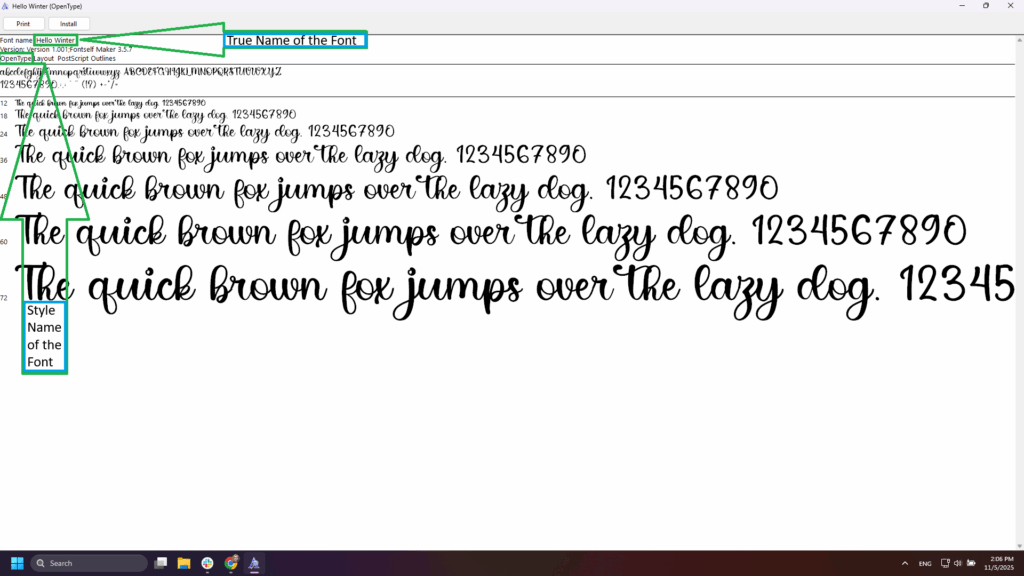
Locations of Font File "true name" and "style name".
Custom Font ‘True name’ and ‘Style name’ locations

💡 Tip: Using the wrong font name is the most common reason fonts don’t show up correctly.


Font File Requirements

To upload a font to Yodeck, your ZIP file (which is analyzed further below) needs to have at least one of these types of font file extension (format) types:

  • .TTF -> TrueType Font: The most common type of font file, supported by almost all systems and browsers.
  • .OTF -> OpenType Font: A newer, more flexible version of TTF that can include extra design and language features.
  • .WOFF -> Web Open Font Format: A version of a font made specifically for the web — smaller file size, faster loading.
  • .EOT -> Embedded OpenType: An older Microsoft web font format. Still supported by Internet Explorer.

👉 You don’t need all of them. One is enough.

info

Delete any .txt file(s)

You might also see a file called OFL.txt or another readme text file, inside your font folder containing the font file. You must delete the ‘.txt’ file so that it is not included in your final ZIP file, as analyzed further below.
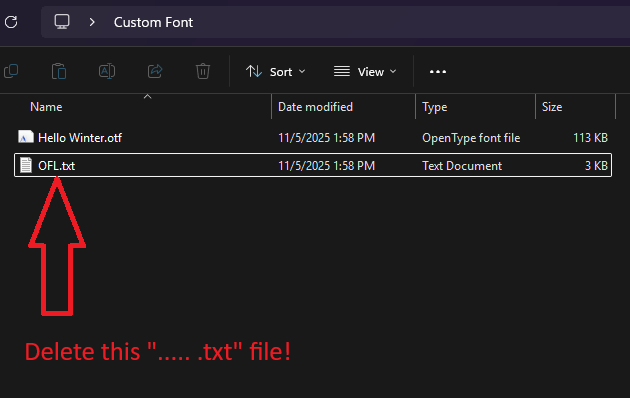
error

Don’t zip the entire folder.

You’ll add the required files later, but make sure to include only the font file (.tff or .otf, or wof, or .eot) and the small font.css file, not the folder that contains them, nor the ofl.txt file.


Create the font.css File

This small file instructs Yodeck where the font is located and how to use it. Without it, the font cannot appear on screen.

  1. Open the Notepad (or Notepad++).
  2. Create a new file and name it font.css.
  3. Then, copy this CSS code example below, inside the newly created file (font.css), by right-clicking it and selecting the Edit in Notepad option.
@font-face {
    font-family: 'YourFontName';
    src: local('YourFontName'), url(./YourFontFile.ttf) format('truetype');
}
  1. Replace 'YourFontName' with the real font name you found earlier inside your actual font file.
    • Example:
      @font-face {
      font-family: 'Hello Winter';
      src: local('Hello Winter'), url(./Hello Winter.otf) format('opentype');
      }
      • ‘font.css’ legend, based on the example above:
        – local -> Contains the true name of the font “Hello Winter”.
        – url -> Contains the path url inside the zip file “./” , followed by the true font name “Hello Winter”, followed by the font file extension “.otf”, also known as font format.
        – format -> Contains the font file extension, also known as the font format, written in full “opentype”.
  2. Replace 'YourFontFile'.otf with the font’s true file name.
    • Example: “Hello Winter.otf”
  3. Save the CSS file (font.css) in the same place where your font file (Hello Winter.otf) resides, for example, on your computer’s ‘Desktop’.

✅That’s it! Both your font file and the font.css file are now ready to be zipped.


Zip Your Files

Before uploading, you must combine your font file and the font.css file into one ZIP file.

✅ Correct ZIP Example❌ Incorrect ZIP Example #1❌ Incorrect ZIP Example #2
Hello Winter.otf
font.css
MyFontFolder/
Hello Winter.otf
font.css
Hello Winter.otf
font.css
OFL.txt

Steps for zipping together the two files

  1. Select both the font.css file and your font file.
  2. Right-click on any of them.
  3. Choose the option: Compressed to… -> ZIP File.
  4. Name the ZIP file (for example, Hello Winter.zip).
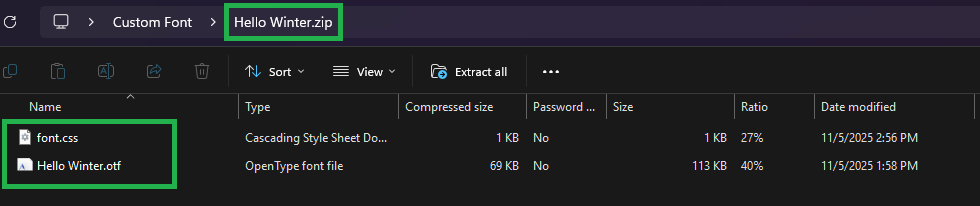
  5. Open the zip file once to verify that you can see the two files directly, without them being inside another folder.
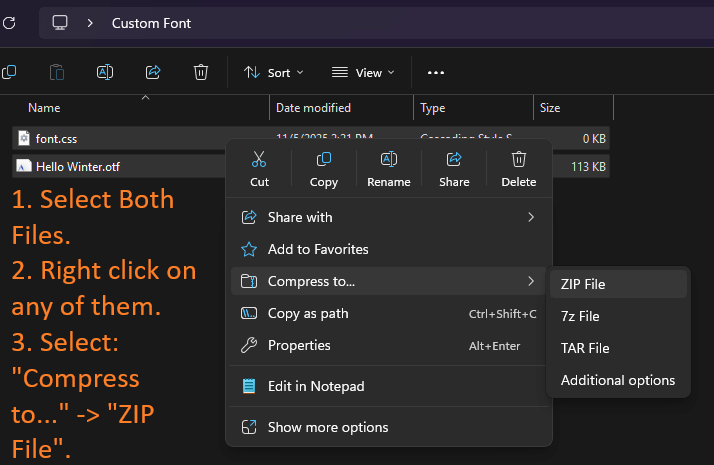
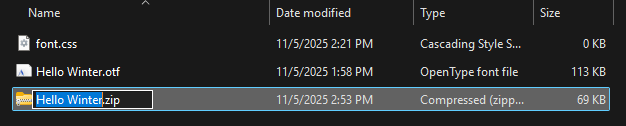
View of a folder in Windows where two files (a '.css' and a '.otf') are selected to be zipped before they become uploaded as a custom font on the Yodeck platform.
Zipping the two files together (Steps #1-3)
View of a folder in Windows where two files (a '.css' and a '.otf') are zipped and can now be uploaded as a custom font on the Yodeck platform.
Providing a zip file name (Step #4)
Zip folder view of a Custom Font zip file in Windows where the user verifies its contents before uploading the zip as a custom font on the Yodeck platform.
Opening the zip file for verification (Step #5)

💡 Tip: If you open the ZIP and see a folder first, go back and zip the files again correctly.


Upload the ZIP to Yodeck

Now you can upload your custom font.

  1. Log in to your Yodeck account.
  2. Navigate to your Profile Icon button > Account Settings > Custom Fonts, and click the ‘+ Add Custom Font‘ button.
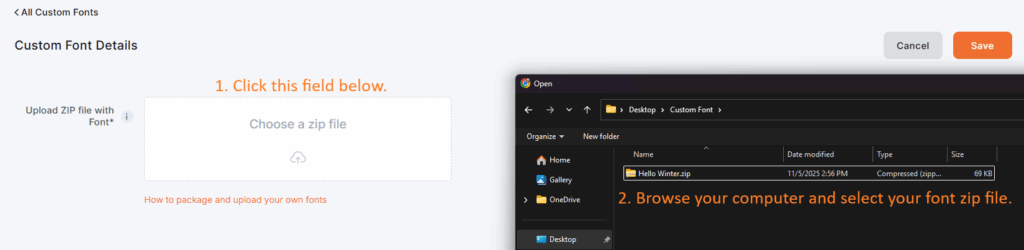
  3. Click inside the Upload field to browse your computer and locate your custom font zip file.
  4. Choose your ZIP file.
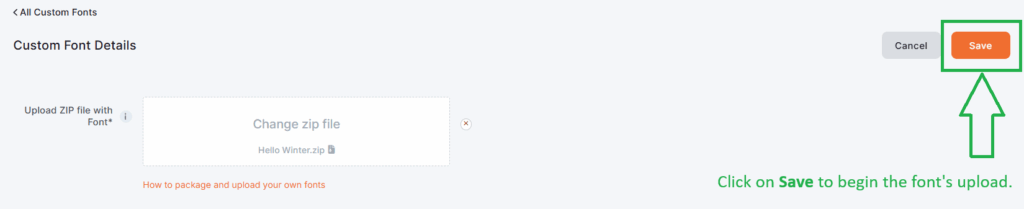
  5. Then, to initiate the actual upload, click Save.
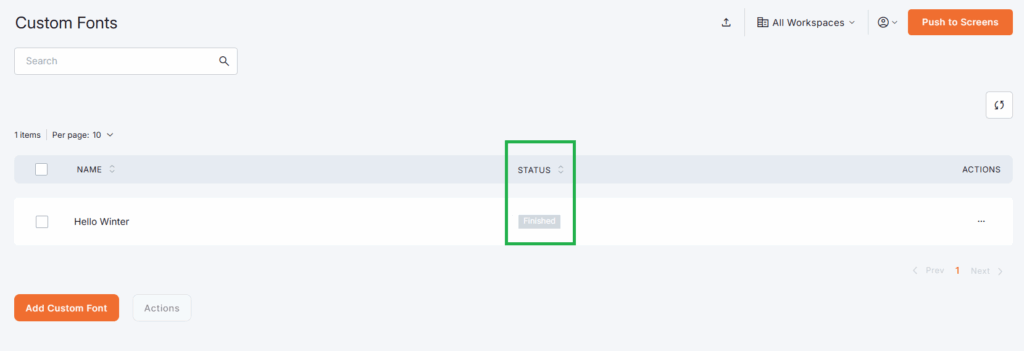
  6. Wait a few seconds until the upload mechanism status changes from ‘Extracting‘ to ‘Finished‘.
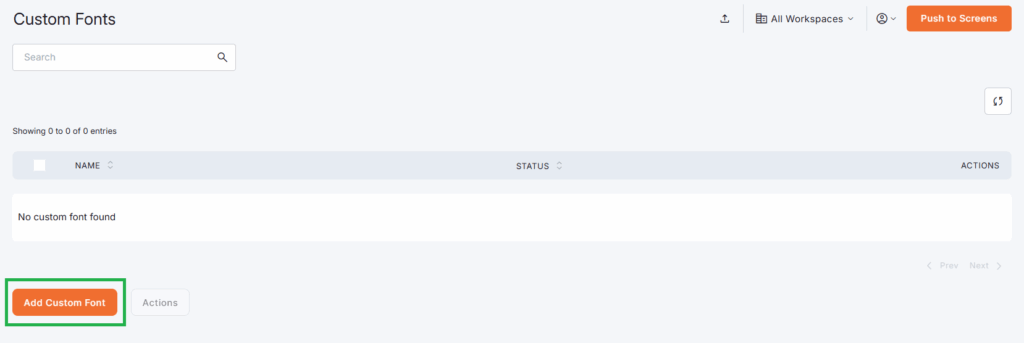
Custom Fonts list inside the user's Yodeck account.
Landing page of Custom Fonts (Step #2)
Yodeck platform page for uploading Custom Fonts inside the user's Yodeck account.
Upload page of Custom Fonts (Steps #2-3)
Yodeck platform page has a Custom Fonts ready to be uploaded inside the user's Yodeck account.
Custom Font upload initiation (Step #5)
Yodeck platform page displaying the finished upload of a Custom Font inside the user's Yodeck account.
Finished upload of Custom Font (Step #6)

✅ Your custom font is now uploaded and ready to be used inside your Text or Default widgets.


Tips

💡 Keep these quick reminders in mind:

  • Double-check the font name matches exactly what’s written inside the font.css file.
  • Avoid spaces or special characters in file names.
  • Fonts from Google Fonts work great.
  • Test your font in a Text widget before publishing your layout.

Troubleshooting

If something doesn’t look right:

  • Make sure your ZIP includes only the font.css file and the font file.
  • Re-check that the font name in your CSS file matches your real font name (be mindful of spaces).
  • Try a different font format, like .ttf, or .woff, or .otf, if it still doesn’t work.
  • Confirm that the upload status indicates ‘Finished’ before using it.

ℹ️If it still won’t appear correctly, reach out to Yodeck Support. We are happy to help!


F.A.Q.s

Got questions? We’ve got answers! This section addresses common questions about the Custom Fonts.

Can I use my custom font on a website I show through Yodeck?

No. Custom fonts only work inside Yodeck’s Text and Default widgets.
They don’t affect websites or other external content.

Do I need every file type (TTF, OTF, WOFF, EOT)?

No. One is usually enough! Just include whichever format your font provides.

My upload keeps failing. What’s wrong?

Most of the time, the ZIP file includes a folder instead of the files directly.
Re-zip your font.css and font file together, without any folder or .txt files inside it.

Can I upload several fonts in one ZIP file?

No. Each ZIP file should contain only one font family file and its matching font.css file.

My font looks strange on screen. Why?

Usually, the font-family name in your CSS doesn’t exactly match the real name.
Open your font file in Notepad again, copy the correct name, and update your CSS file.


Need Help?

The Yodeck Support Team can help you out! Log in to your Yodeck account and send us a message from the bottom right corner!


  • Homepage
  • General
    • What is Digital Signage
    • Free Signage Software
    • Raspberry Pi Signage
  • Product
    • Features
    • Apps
    • Free Signage Templates
    • Solutions
  • Support
    • Contact
    • Support Center
    • Give Feedback
    • FAQ

Copyright © 2015-2026 Flipnode LLC | All rights reserved.