Overview
If the predefined user roles do not provide the permissions you want for your users and you need more specific control over what certain users can do, you can use our Custom Roles feature with the Enterprise Plan. This allows you to define exactly what items users are allowed to view, change, or delete.
To set up a custom role, go to your Account settings, navigate to Custom Roles, click the Add Custom Role button, and fill out the table with the actions that you want a user to be able to perform.
Use a Custom Role when:
- A job function doesn’t map to a standard role (an IT technician who manages screen configuration but never touches content)
- You want a team to manage media files without access to app instances, or the reverse
- You need to limit access for security or compliance reasons
Create a Custom Role
If you need to provide a User with customized Permissions, you need to create a Custom Role.
Navigate to the Account Settings > Custom Roles, click the Add Custom Role button, enter a Name (required) and Description (optional), tick the permissions you want to grant, and lastly, click the Save button.
You can see all the Predefined Roles and the Custom Roles you created on this screen.
In the Standard Roles, clicking the magnifying glass button displays the detailed permissions for that Role.
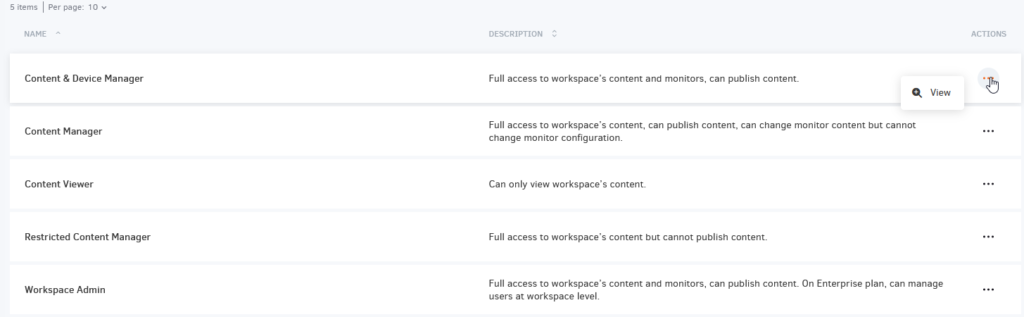
You can add a Custom Role and define the detailed Permissions this Role will provide.
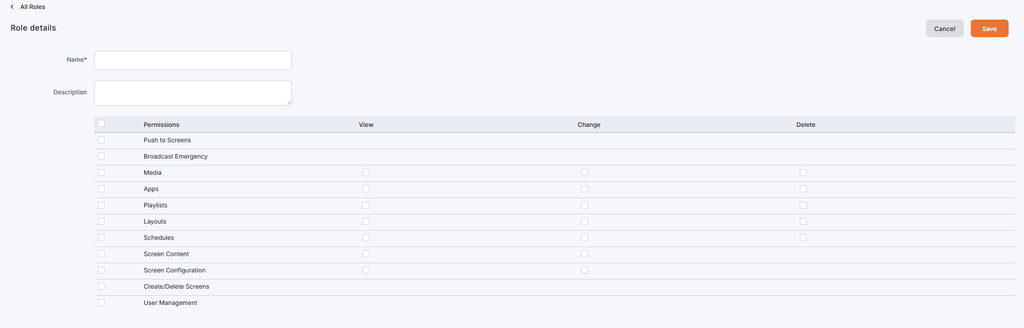
Permissions
The Role details form lists every permission a custom role can grant. Tick the checkbox at the start of a row to select all its actions, or tick the checkbox in the table header to select everything.
| Permission | Actions |
|---|---|
| Push to Screens | On or off |
| Broadcast Emergency | On or off |
| Media | View, Change, Delete |
| Apps | View, Change, Delete |
| Playlists | View, Change, Delete |
| Layouts | View, Change, Delete |
| Schedules | View, Change, Delete |
| Screen Content | View, Change |
| Screen Configuration | View, Change |
| Create/Delete Screens | On or off |
| User Management | On or off |
Media and Apps are separate permissions. Media covers the files in your Media library (images, videos, documents, audio, and web pages). Apps covers app instances such as weather, calendar, and RSS apps.
⚠️There is one exception: if you grant a user the Apps permission to at least “View” Apps, the system automatically applies the “View” permission to Media as well.
Custom Role Example
A content team uploads images and videos and keeps playlists current, while one person manages the weather and RSS apps. Create a role named Media Contributors with Media (View, Change, Delete), Playlists (View, Change) and Push to Screens on, and leave Apps unticked. Members can upload, replace and delete media files, add them to playlists and push to screens. They cannot view, edit or add app instances.
Need Help?
The Yodeck Support Team can help you out! Log in to your Yodeck account and send us a message from the bottom right corner!

