


How screens help liquor retailers sell more, stay compliant and compete with the grocery aisle.
Key Takeaways
Screens can earn twice: they can help spotlight featured bottles and create promotional space for distributor campaigns.
Compliance can run on a schedule: age reminders and disclaimer notices can be updated across locations without reprinting signage.
Placement matters more than screen count: the closer a screen is to the product it promotes, the more likely shoppers are to notice the message.
The platform shapes the real workload: it determines whether a price update takes minutes or becomes a multi-step task.
At 6 PM on a Friday, the register line grows, a shopper hesitates in the wine aisle, and an outdated whiskey promotion stays on the shelf because no one had time to replace it. Those small moments can cost sales.
Digital signage for liquor stores helps teams promote timely offers, guide purchase decisions, and keep messaging current. This guide covers practical content ideas, print-versus-digital tradeoffs, key software features, startup costs, and where retail digital signage fits for independent stores and chains.
Why liquor stores are investing in digital signage in 2026
A Journal of Marketing field study covering 237 campaigns and 30 million shoppers in food retail found that in-store digital signage increased the likelihood of buying the featured product by 8.1%. The effect was stronger for hedonic products, new items, low-priced products, popular brands, weekend shopping, and later-day visits.
Those conditions closely match many liquor store purchases, especially around evenings, weekends, seasonal releases, and gift occasions. Here are six practical reasons digital signage for liquor stores can change what happens in-store.
1. Creates a new revenue stream with in-store advertising
Advertising networks allow liquor store owners to generate revenue directly from the brands they already sell. Instead of relying solely on product margins, you can monetize screen space by offering paid promotional placements to distributors, wineries, breweries, and premium spirit brands.
You can:
- Sell rotating ad placements to suppliers
- Offer seasonal sponsorship packages
- Partner with local restaurants for pairing promotions
- Run cross-promotional campaigns with nearby businesses
A useful side effect: better marketing relationships with your best-selling brands.
Compliance note: Alcohol advertising rules vary by country, state, and license type. Review local requirements for content, audience, placement, and timing before displaying paid promotions.
2. Acts as a self-service sales assistant
A shopper comparing two familiar wine labels often makes a quick default choice: the better-known, lower-priced bottle.
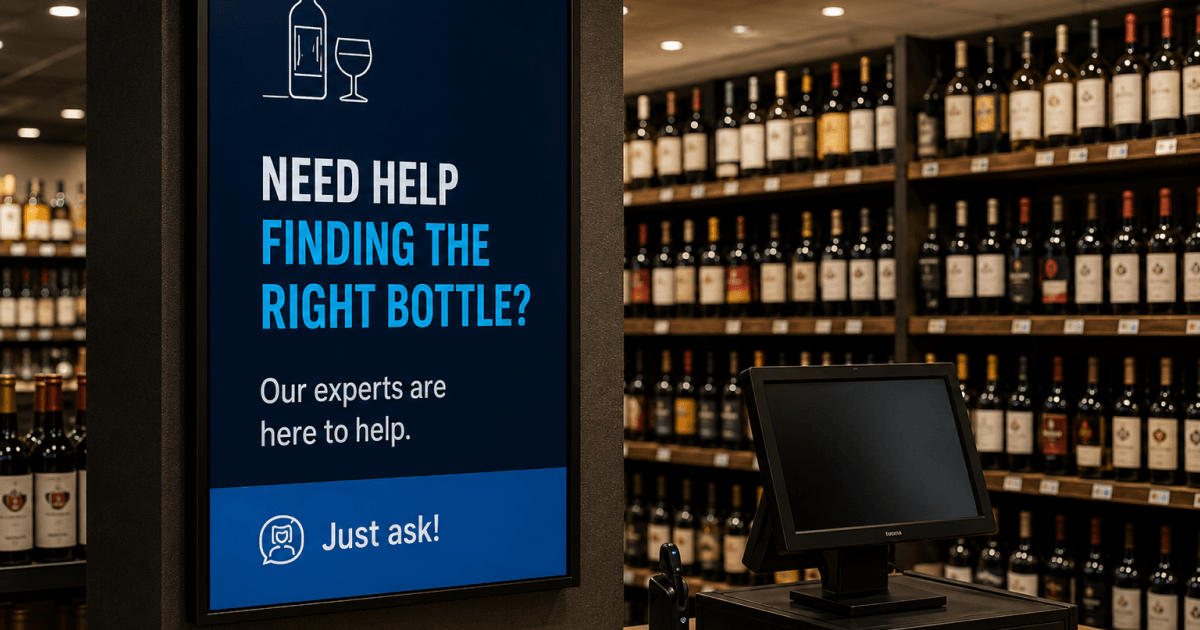
A display beside the shelf can give that decision more context. Show tasting notes, food-pairing suggestions, and a clearly positioned premium alternative, so shoppers have a reason to trade up without needing to find an employee. Add an interactive kiosk and they can browse categories themselves, compare two labels and see what sits one tier up.
Interactive screens can also run brief surveys, helping retailers understand what shoppers came in to buy and how a promotion influenced their decision.
3. Simplifies product discovery
Many liquor-store shoppers arrive with a familiar bottle in mind. They may browse for a moment, but crowded shelves and small price tags rarely make it easy to compare styles, discover a new producer, or understand what makes one option different from the next.
Digital menu boards bring that information into view. A single screen can organize wine, beer, and spirits by category; spotlight limited-time offers; and give shoppers useful context that will not fit on a shelf label, such as tasting notes, country of origin, grape variety, mash bill, or food-pairing ideas.
The biggest operational advantage is speed. When inventory changes, a distributor launches a promotion, or a craft beer starts trending, you can update your content in seconds, without reprinting, delays, or wasted materials.
4. Customizes every zone of your store
Not every screen should display the same message. Customers have different needs and priorities depending on where they are in the store.
- Entrance screens can introduce featured products, promotions, or what is new that day.
- Aisle displays can help shoppers compare options as they browse.
- Checkout screens can encourage last-minute add-ons.
Instead of treating the store as one flat space, screens allow you to design the customer journey.
With a multi-zone setup, each display can serve a distinct purpose. For example, a liquor store could feature a premium bottle in one area, promote an upcoming tasting event in another, show live prices elsewhere, and keep age-verification messaging visible across the bottom of the screen.
5. Strengthens compliance
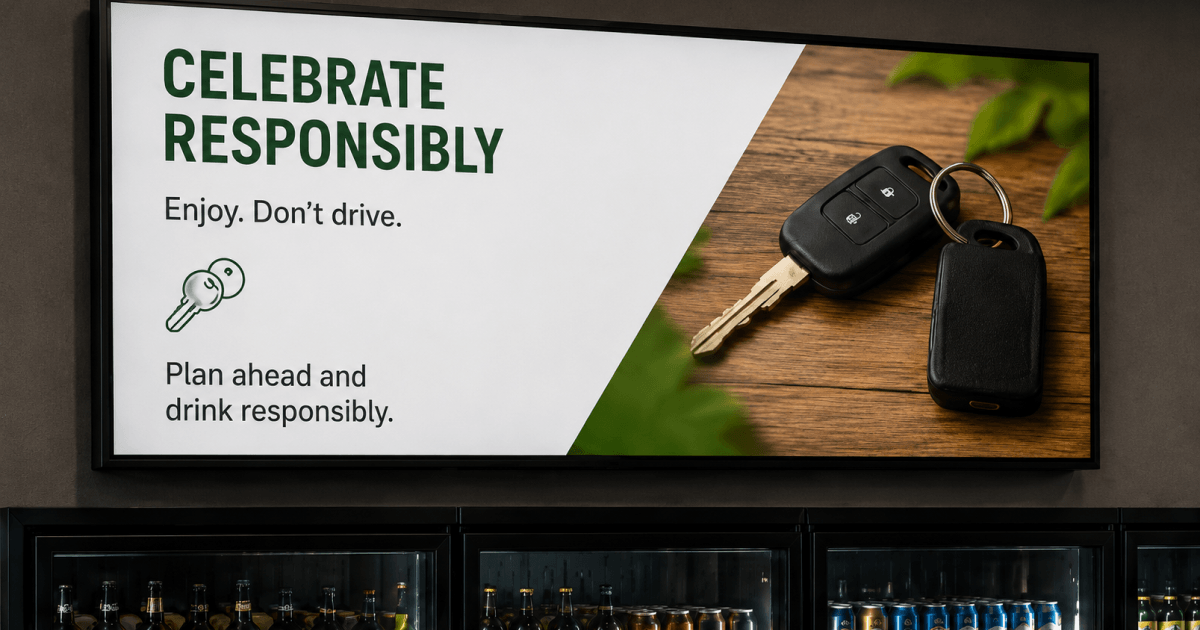
Alcohol retail is highly regulated, so required signage must remain visible, accurate, and up to date throughout the store. This includes age-verification reminders, responsible-drinking messages, and legally required disclaimers.
With liquor store digital signage, these messages can be scheduled and managed centrally. If wording changes, the update can appear across every screen and location at once, without relying on staff to print and post new notices manually. For owners, that means fewer compliance gaps and less stress during inspections.
6. Competes with grocery and convenience stores as “alcohol outlets”
Liquor stores no longer compete only with other liquor stores.
Across the U.S., grocery and convenience stores are increasingly becoming alcohol destinations. Although licensing rules vary by state, many markets allow supermarkets and fuel-linked convenience stores to sell beer, wine, and, in some cases, spirits. Convenience stores accounted for $14.7 billion in beer sales in 2013, according to National Association of Convenience Stores data published by NABCA.
So where does that leave independent liquor retailers?
Grocery chains win on convenience and volume. Liquor stores win on specialization, expertise, and curated selection.
Used strategically, liquor store digital signage helps make that difference visible. It can turn the store into a more engaging retail destination, putting expertise in front of shoppers, encouraging higher-value purchases, and building stronger customer loyalty in an increasingly competitive market.
Related reading: see how the same tactics play out in grocery digital signage and supermarket digital signage.
Why digital signage is ideal for small liquor shops
There’s a common misconception that digital signage is only practical for large chains with large budgets. That is no longer the case.
Even one screen behind the counter can make a noticeable difference for a neighborhood liquor store. It can promote weekly specials, spotlight high-margin bottles, and introduce new arrivals, without the cost and waste of printed posters.
For small store owners, the key question is not simply whether digital signage is affordable. It is how quickly it can pay for itself through better promotion, stronger product visibility, and higher-value purchases.
Modern setups are more accessible than many retailers expect:
- Affordable commercial displays
- Low monthly software costs
- No complex IT infrastructure
- Plug-and-play media players
- Ready-made templates you edit yourself
Small retailers do not need an in-house designer, marketing department, or enterprise-level hardware. With simple templates and scheduling tools, a liquor store can create a polished, professional in-store experience that rivals larger chains.
Why digital signage is ideal for large liquor chains
For larger operations, the focus shifts from affordability to scalability.
Digital signage gives multi-location liquor retailers a practical way to manage in-store communications at scale. Instead of emailing posters to each branch or relying on store managers to update content manually, headquarters can control messaging across dozens (or even hundreds) of locations from one central dashboard.
That makes it easier to maintain:
- Consistent branding across every store
- Location-specific promotions when needed
- Scheduled campaigns that launch automatically
- Role-based access for regional and store managers
It can also improve the customer journey. Larger liquor stores can use wayfinding digital signage to direct shoppers to specific categories, premium sections, tasting areas, or event spaces.
The outcome is more than better-looking screens. It is greater operational control: campaigns launch on time, compliance messaging stays consistent, and promotions do not rely on someone remembering to replace a poster.
Whatever the size of your business, book a demo and see how Yodeck fits your liquor store.
Fun fact about liquor stores in the USA
If you’ve ever been in Massachusetts, you might have heard someone say they’re going to the “packy.” They don’t mean a package pickup point, they mean the liquor store.
In several parts of the U.S., liquor stores are still called “package stores.” And no, it has nothing to do with brown paper bags.
In the late 1800s, Supreme Court rulings on interstate commerce let retailers sell alcohol inside dry states as long as it stayed in its original, sealed packaging. Shops that used the loophole became known as “original package stores.” Congress closed it with the Wilson Act in 1890, but the name stuck, and after Prohibition several states wrote the original-package rule into law to stop retailers re-bottling liquor or selling it loose.
Other parts of the country landed on their own names for the same kind of shop:
- “ABC Stores” in North Carolina
- “State stores” in Pennsylvania
- “Party stores” in Michigan
- “Red dot stores” in South Carolina
From those early licensing fights to today’s compliance-heavy retail environment, liquor sales in the U.S. have always been shaped by regulation. And that regulatory influence still plays a major role in how stores operate, advertise, and communicate with customers today.
Liquor store signage ideas: what to display on screens
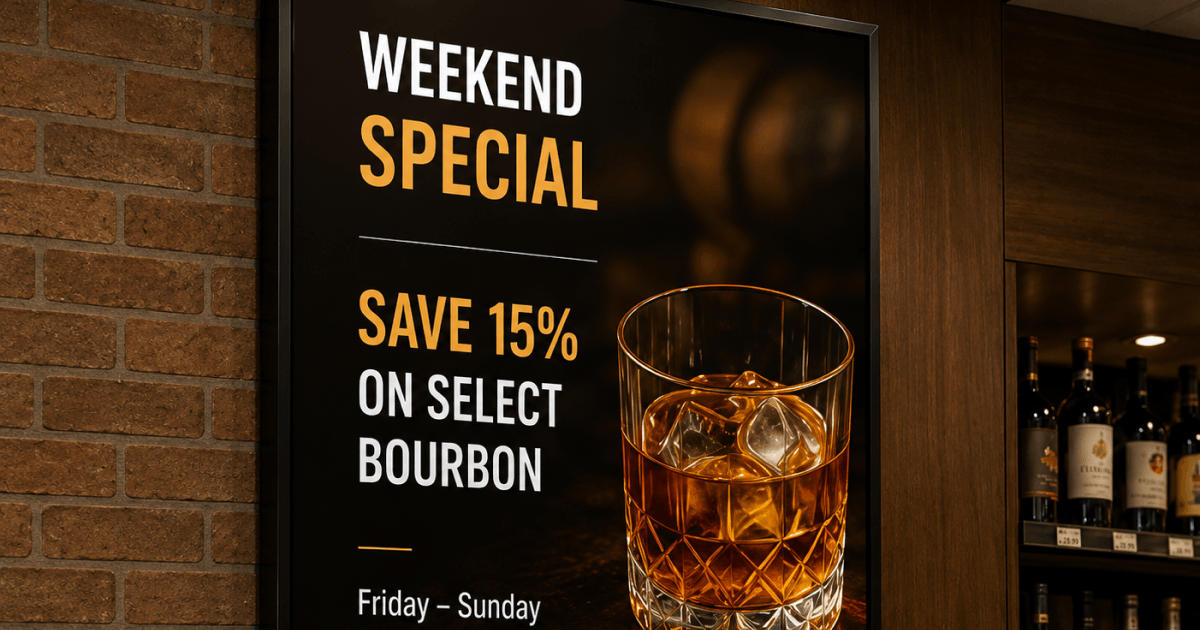
- Deal of the day: Promote daily specials near the register and schedule them to rotate automatically.
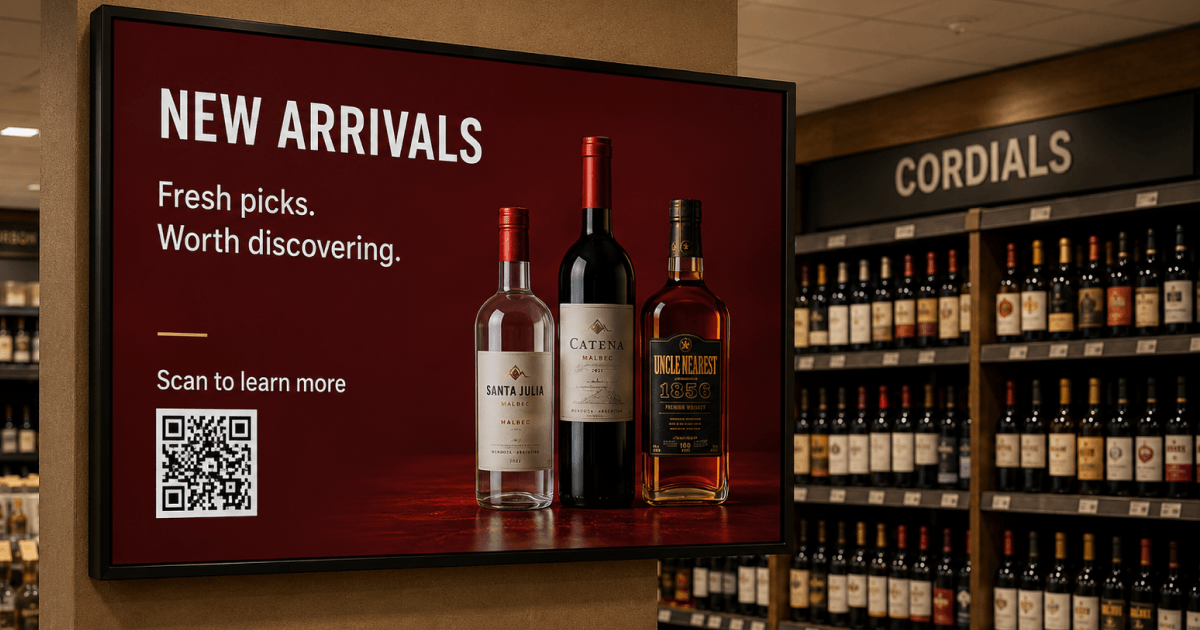
- New beer and wine arrivals: Feature new stock as soon as it lands to help shoppers discover something different.
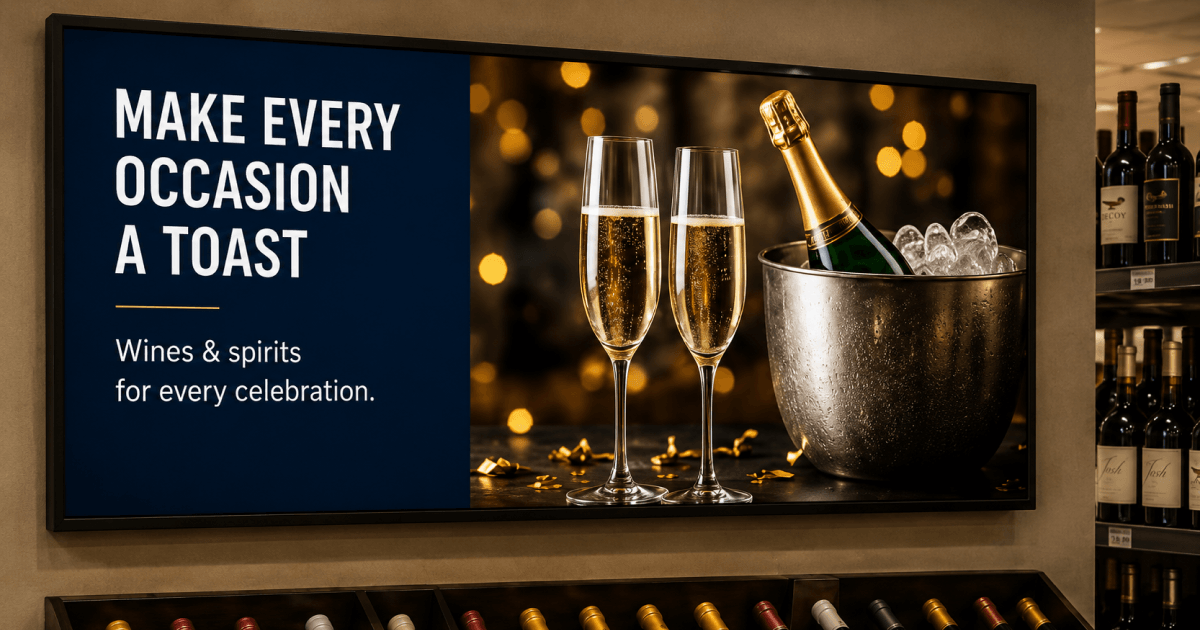
- Featured premium or top-shelf bottles: Use 4K video and high-resolution visuals to give premium products the presentation they deserve and justify higher price points.
- High-margin bundles and combo offers: Promote curated sets (e.g., whiskey + glasses). Multi-zone layouts let you show pricing, visuals, and pairing suggestions on one screen.
- Seasonal promotions: Schedule summer craft beer, holiday gift boxes, or game-day spirits weeks in advance.
- Wine reviews and detailed tasting notes: Display ratings, flavor profiles, and food-pairing ideas beside the relevant shelf.
- Origin, ingredients, and production stories: Tell the story behind local distilleries or wineries. Short looping videos make your liquor store digital signage feel curated, not transactional.
- Food pairing suggestions: Promote wine-and-cheese combinations or cocktail recipes. Pair this with a Weather App to adapt messaging (e.g., refreshing summer cocktails on hot days).
- In-store tasting events and sampling times: Promote upcoming tastings using pre-scheduled playlists. Add countdown timers to create urgency.
- Cocktail-making tutorials: Short educational clips increase engagement while subtly promoting specific bottles and mixers.
- Social media feeds and customer content: Show tagged posts and customer photos to add social proof and encourage participation.
- Branded hashtag campaigns: Encourage customers to share purchases for a chance to be featured on screen. Great for building community visibility.
- QR codes for exclusive discounts: With QR code integration, customers can scan and unlock limited-time offers, bridging in-store experience with digital engagement.
- Staff introductions and picks: Introduce the team and what they drink. Staff recommendations are the cheapest expertise signal a store has.
- Spotlight on local and craft producers: Feature small-batch brands and partnerships that larger grocery chains may not carry.
- Limited-edition or rare bottle announcements: Announce allocated bottles as soon as they arrive to create timely, genuine urgency.
- Non-alcoholic options visibility: Give alcohol-free products meaningful screen space to support shoppers seeking more choice.
- Responsible drinking reminders: Schedule age-verification messages and compliance disclaimers consistently across screens to reduce risk.
Looking beyond liquor retail? Browse more digital signage ideas for retail and the retail digital signage apps that power them.
Yodeck features that make liquor store content easy to create and manage
Most liquor store managers will not sit through a training program to publish a price change. What they need is a digital signage CMS that a busy liquor store manager can run between deliveries. Yodeck holds a 4.7 out of 5 rating on G2 from more than 3,000 verified reviews, and ease of use is the strength reviewers mention most.
Here’s how it fits the liquor retail environment specifically:
Drag-and-drop editor
No design experience required. Managers can build promotions, price highlights, tasting announcements, and compliance messages by placing images, video, text, and QR codes into a visual layout. It is well suited to last-minute distributor deals and weekend specials.
Free templates designed for retail
Rather than starting from a blank screen, stores can customize ready-made retail designs with their own branding, pricing, and product imagery. Yodeck offers more than 800 free digital signage templates, making it easy to create reusable layouts for seasonal campaigns and recurring promotions.
Multi-zone screen layouts
Liquor stores often need to display multiple messages at once. With multi-zone layouts, one screen can show: a featured bottle, a rotating deal of the day, a tasting event banner and age-verification text, all on the same display.
Advanced scheduling
With built-in scheduling tools, stores can pre-schedule holiday campaigns, run happy-hour promotions at specific times, rotate weekend-only offers, and automate compliance messages. Campaigns launch automatically. No one has to remember to change a poster.
Remote and real-time updates
Change pricing or swap a promotion across one screen or every location from a single dashboard, without visiting a store.
User permissions
Every plan includes unlimited users and standard roles, so a weekend employee can change the deal of the day without touching your billing or your players. Enterprise adds custom roles and Workspaces for chains that need head office and individual stores kept apart.
Offline playback
Content continues playing from local storage if the internet connection drops, helping prevent blank screens during busy periods.
Screen offline alerts
Email notifications let teams know when a player goes offline, so problems can be addressed before customers notice.
Embeddable feeds
Extend your liquor store digital signage beyond in-store screens. With Yodeck’s Embeddable Feeds, available on Enterprise Plus, you can display the same promotional playlists, event posters, or branded layouts on your website or intranet via secure embed code or share link.
Magic Layout
Describe the screen you want, such as a weekend whiskey promotion with three bottles and prices, and Magic Layout returns two editable layouts in a few minutes. Teams retain control over final pricing, event details, and media, while account owners switch AI features in Account Settings > AI Content Creation.
Built for busy liquor store owners and managers
You do not need a marketing department to get started. Place a screen where buying decisions happen, such as behind the register or above a premium shelf. Schedule a week of content: the day’s offer, featured bottles, supplier promotions, and required compliance messaging.
Screens do not sell bottles on their own. Relevant content does. The software behind the screen determines whether keeping prices, promotions, and notices current takes a few minutes or becomes another job for the weekend.
Yodeck offers a free plan, giving you a low-risk way to test digital signage in your liquor store before committing to a larger rollout.