


DOOH explained in plain terms, from what the acronym means to how the screens in your own venue can earn ad revenue.
DOOH is OOH on a screen. Same public-space advertising, delivered digitally so the creative can change by time, place and context
Billboards can be either. Printed means OOH, LED means DOOH. The difference is how the ad gets there, not where it sits
Place-based screens are the growth format. Retail, transit and venue screens, not roadside boards, are where digital inventory is expanding fastest
Screen owners are the other side of DOOH. Any business with screens and foot traffic can sell ad time, and most guides ignore them entirely
A sellable screen needs four things. Scheduling, controlled ad rotation, proof of play and content that keeps the screen worth watching
Most explanations of DOOH advertising are written for media buyers at agencies. They cover formats, targeting and programmatic pipes, then stop. That leaves out the people who own the screens: the gym with a display at reception, the pharmacy chain with 40 waiting-room screens, the stadium with sponsors asking for airtime. If you run screens in a place where people gather, you are already holding DOOH inventory, whether or not you have sold a single slot.
This guide covers both sides. First the definition, the OOH comparison and the formats that searchers and buyers mean when they say DOOH. Then the part the adtech guides skip: how screen owners price, schedule and prove ad time, and what your setup needs before the first invoice goes out.
What is DOOH advertising?
DOOH advertising is digital out-of-home advertising: paid messages shown on digital screens in public places, such as roadside LED billboards, screens in train stations, and displays inside stores, gyms, clinics and restaurants. The “out-of-home” part means the audience sees the ad while out in the world rather than on a personal device. The “digital” part means the screen is connected, so the ad can be scheduled, swapped and targeted remotely instead of printed and pasted.
Remote control is what changed the economics. A printed poster is sold to one advertiser for a fixed period. A digital screen rotates several advertisers through the same slot, changes the message by time of day, and reports what actually played. The same square meter earns more and the operator does less physical work to earn it, which is how a venue ends up running its own digital signage advertising network rather than leasing wall space to a media company.
The venue owner’s version of that trade is small and local: a flat monthly fee from the business next door rather than a national media buy, with the same playback rules behind it.
One distinction worth settling early: DOOH is not the same thing as digital signage. Digital signage is the technology, the screens, players and software that put content on a display. DOOH is one use of that technology, the advertising channel that runs on it. A menu board is digital signage. The supplier ad that rotates between menu items on the same board is DOOH.
The rest of this guide covers how DOOH differs from traditional OOH, the formats it takes, how campaigns are bought and measured, and how screen owners turn their displays into ad revenue.
What is the difference between DOOH and OOH?
OOH is the whole category of advertising people see outside their homes. DOOH is the digital subset of it. Every DOOH placement is OOH, but a printed billboard, a bus wrap or a poster in a shelter is OOH only. The difference is in how the ad is delivered, updated and sold, not in where the audience is standing.
| Traditional OOH | DOOH | |
|---|---|---|
| Delivery | Printed, pasted or wrapped | Played on a connected screen |
| Time to change creative | Days to weeks, with production cost | Minutes, no production cost |
| Advertisers per placement | One per period | Several rotating in a loop |
| Scheduling | Fixed for the booking | By hour, day, weather or trigger |
| Targeting | Location only | Location plus time, context and audience data |
| Proof the ad ran | Photo of the installed poster | Playback log per screen and per slot |
| Who owns the placement | Media companies, mostly | Media companies and venue owners |
| Typical buy | Four-week period | Share of a loop, dayparts or impressions |
The bottom two rows matter most for this guide. Traditional OOH inventory is concentrated in a handful of large media owners because building and permitting a billboard is expensive. DOOH inventory is wherever a screen already exists, which puts gyms, retailers, hospitals and transit operators on the selling side for the first time.
Digital is taking share from print inside a category that is itself still growing, so the choice for a venue is not whether screens will carry ads but who gets paid when they do.
Are billboards OOH or DOOH?
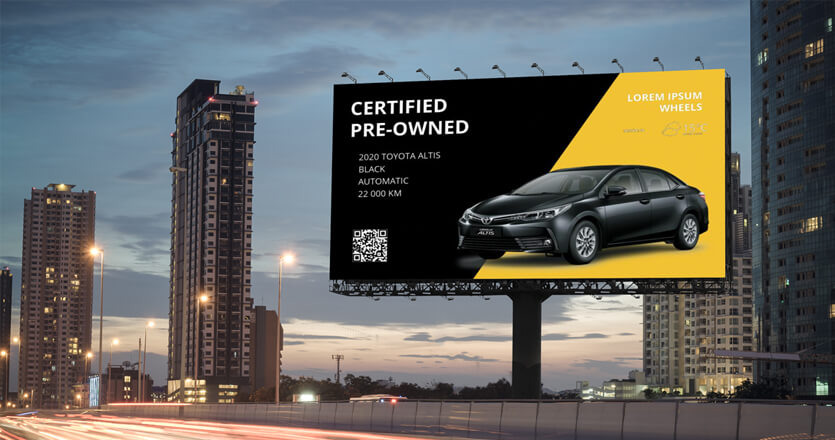
Both, depending on the billboard. A printed vinyl billboard is traditional OOH. An LED billboard that cycles through several advertisers is DOOH. Same pole, same road, same audience. The classification follows the delivery method.
The practical test: if changing the ad means sending someone up a ladder, it is OOH. If it means uploading a file and picking a time slot, it is DOOH. Roadside digital boards are the format most people picture, but they are not where the growth is. That is happening indoors, on venue screens, which is where the next section starts.
DOOH advertising examples and formats
DOOH formats are grouped by where the screen sits and how long people stay in front of it. The four below cover almost every digital out-of-home example you will meet, and the growth figures show which ones are expanding. In Q1 2026, digital accounted for 36% of US out-of-home revenue and grew 12.9% year over year against 4.1% for print, and the OAAA put digital transit revenue up 25%, digital street furniture up 21.5%, digital place-based up 17% and digital billboards up 8.1%. The formats closest to where people shop, wait and travel are growing two to three times faster than roadside boards.
Digital billboards and large format
Roadside LED boards, building wraps and spectaculars in city centers. These boards sell reach: thousands of passing cars or pedestrians per hour, each seeing the ad for a few seconds. Advertisers buy a share of a loop, typically an eight-second slot repeated every minute or so, and the board owner runs several brands in rotation. A single venue rarely operates one of these, though Yodeck does support outdoor LED billboards, including boards with unusual resolutions, from the same account that runs the indoor screens.
Transit and street furniture
Screens in rail and bus stations, on platforms, inside vehicles, at bus shelters and on kiosks. People wait here, often for several minutes, which allows longer creative and sequences of messages. Transit operators mix passenger information with ads on the same screen, which is why digital signage in transportation is as much an advertising story as an operations one.
Place-based screens
Screens inside venues: gym reception areas, hotel lobbies, clinic waiting rooms, bars, cinemas, office buildings, university campuses, stadium concourses. The audience is defined by the venue, which is the selling point. A sports nutrition brand does not need audience data to know who is standing in a gym at 6PM. Place-based is where most venue owners enter DOOH, because the screens already exist for wayfinding, menus or internal messaging, and the ad slots are added to a loop that is already running. Retail digital signage works the same way: the promotion screen at the entrance becomes the supplier-funded screen at the entrance.
Retail media and point-of-sale screens
The newest and best-funded DOOH format. Retailers sell screen time inside their stores to the brands on their shelves, usually as part of a wider retail media network that also covers their website and app. Endcap screens, cooler doors, checkout displays and shelf-edge strips all count. Brands pay because the ad reaches the shopper within arm’s reach of the product. Large grocers built this model, but a regional chain with the right types of retail digital displays can sell the same inventory to the same suppliers, at smaller scale.
Across every format, the audience response is what advertisers are paying for. In a Harris Poll study for the OAAA, 73% of US adults said they view DOOH ads favorably, against 50% for TV and 48% for social, and 76% said a DOOH ad had recently prompted them to act. If your screens sit in front of a captive audience, that favorability is the asset you are selling.
How are DOOH campaigns bought and measured?
DOOH is bought three ways, and the route determines who the screen owner deals with. A direct buy means the advertiser or agency contacts the media owner, agrees a price for a set of screens and a period, and sends the creative. A network buy means a DOOH media company aggregates screens from many venues, sells the whole package to brands and pays each venue a share. A programmatic buy means the inventory is listed on an exchange and bought automatically, impression by impression, through the same demand-side platforms that buy display and video ads.
Programmatic DOOH is the fastest-moving of the three and deserves its own guide. For this one, the short version: it is how national brands buy venue screens at scale without talking to each venue, and it requires the screen owner to connect to a supply-side platform that lists and prices the inventory. For a single venue or a small chain, direct and network buys come first. Programmatic becomes relevant once the screen count and audience data justify the integration work.
Pricing follows the buy. Direct deals are usually a flat monthly rate per screen or per loop share, set against a digital signage cost you are mostly paying already. Network and programmatic deals are priced per thousand impressions, with the impression count estimated from venue traffic. Either way, the buyer is paying for a known audience in a known place, so the clearer you can describe both, the stronger the price.
What are the challenges of DOOH advertising?
Measurement is the one buyers name first. In a 2026 Azerion survey of 128 UK agency and brand buyers, 58% said measurement and attribution uncertainty was the biggest obstacle to spending more on DOOH, and only 41% were satisfied with current OOH measurement. Buyers want the channel. They do not yet trust the reporting behind it, and that doubt lands on whoever is selling the screen.
The response data exists; it is the link between a screen and an action that is hard to prove. YouGov found that 35% of Americans who saw an out-of-home ad researched the product on their phone and 12% scanned a QR code or tapped an NFC tag. For a screen owner, those two numbers point to the cheapest proof you can offer: a unique QR code or promo code per advertiser, so the buyer sees scans and redemptions tied to your screens rather than a footfall estimate.
The other recurring challenges are creative and inventory. Creative built for a phone or a TV does not work at a glance from four meters away, so buyers need venue-specific formats and sellers need to enforce them. And inventory is finite: a loop has a fixed number of slots per hour, and every slot sold to an advertiser is a slot not showing the content people came to the screen for. Managing that balance is the core skill of a screen owner, and it is where the next section goes.
How do screen owners make money from DOOH?
Screen owners earn from DOOH by selling time in the loop that already plays on their screens. The screen, the player and the audience are sunk costs. The ad revenue is margin on top. That is why a venue can profitably sell a slot for a price a billboard company would never get out of bed for.
The question everyone asks first, how much a digital screen makes, has no single answer because it depends on three things: how many people pass the screen, how many of them the advertiser wants, and how many slots you can sell without ruining the loop. A roadside LED board in a city earns thousands per month from national brands. A single screen in a neighborhood gym earns a few hundred from the physio next door and the smoothie bar across the street. Both are DOOH. The gym screen is the version most venue owners can start this month.
There are three revenue routes, and they stack:
- Sell directly to local businesses. The dentist, the realtor, the car wash. Local businesses cannot afford a billboard but will pay a flat monthly fee for a slot in front of your customers. Low price per slot, high margin, no intermediary.
- Charge the suppliers you already stock. Retailers, pharmacies, bars and gyms all carry brands with trade marketing budgets. A slot promoting their product at your point of sale is retail media at local scale, and usually the highest-value route per slot.
- Join a network that fills your inventory. A DOOH media company sells your screens as part of a larger package and pays you a share. Lower rate per slot, no sales effort, and it is how national brands reach venues they would never contact individually.
A multi-site operator usually runs all three: suppliers on the entrance screen, local advertisers in the waiting area, a network partner filling the slots nobody else bought. A shopping mall is the clearest example, with tenants, brands and a media partner all buying time on the same screens.
R.S.C. Anderlecht shows the direct route at stadium scale. The Belgian football club sells sponsor content on its stadium screens and digital totems per match, with the same system also running locker-room screens for staff information. The sponsors pay for airtime on match day; the club controls the loop from one place and keeps the non-sponsor content in rotation between the ads.
What you need before you sell the first slot
Four things, and none of them is a sales deck.
First, a loop with a known structure. If the loop is two minutes long and an ad slot is 10 seconds, you have 12 slots and can promise an advertiser a one-twelfth share of voice. Without this, you cannot price anything.
Second, scheduling by time of day. The coffee brand wants mornings, the bar wants evenings, the gym’s own class promotion wants the hour before each class. Dayparting is what makes the same slot sellable twice.
Third, proof of play. A playback log showing which file played on which screen at what time is the invoice backup. Buyers who have just told a survey they do not trust DOOH measurement will ask for it, and the venue that can send a report wins the renewal over the one that cannot.
Fourth, content people want to look at. A screen that is all ads is a screen nobody watches, and advertisers notice. Keep the schedule, the news feed, the menu or the match stats in the loop. The ads borrow attention from the content around them.
💡 Pro tip by Yodeck Team: Set an expiry date on every ad file when you upload it. Campaigns that run past their paid period are the most common way a small network loses money, and an expiry date removes the file from rotation without anyone remembering to do it.
Running DOOH on your own screens with Yodeck
The four requirements above map onto standard features of a cloud digital signage software, which is the point: a venue does not need an adtech stack to sell its first slots. Yodeck’s DOOH advertising software runs the loop, the schedule and the reporting from one dashboard, whether that is one screen at reception or a few hundred across sites.
The loop is a playlist. You drag ad files and your own content into order, set each item’s duration, and the share of voice is fixed by construction. Schedules then decide which playlist plays when, by hour, weekday or date range, so the morning advertiser and the evening advertiser never collide. Advanced media scheduling goes one level deeper and restricts an individual file to specific hours and days, which is how one playlist serves several dayparts.
Proof of play comes from Playback Reports, available on Premium and Enterprise plans. The report lists every item played on every player, which is exactly what an advertiser’s finance team asks for before paying an invoice. Media Expiration, on every plan, retires a file at the end of its paid period automatically. Working Hours powers screens off when the venue is closed, so you are never billing airtime to an empty room.
For venues that want ads beside content rather than instead of it, multi-zone layouts split the screen: the class schedule or menu on one side, the ad slot on the other, a ticker along the bottom. Multi-site operators on Enterprise can also give each location its own Workspace, so a local manager sells and schedules local slots without touching the rest of the network.
Yodeck is listed at #48 in G2’s 2026 Top 50 Marketing & Digital Advertising Products, which is the category a venue selling ad time actually competes in. The free plan covers one screen, which is enough to build a loop, schedule it and find out whether your local advertisers will buy before you pay for anything.
No credit card required
DOOH advertising FAQs
What does DOOH stand for?
DOOH stands for digital out-of-home. DOOH is the industry term for advertising on digital screens in public places, as opposed to OOH, which covers all out-of-home advertising including printed formats. You will also see it written as digital out of home or DOOH media, which mean the same thing.
Is DOOH the same as digital signage?
No. Digital signage is the hardware and software that puts content on a screen. DOOH is one of the things you can do with it. A screen showing a hotel’s own breakfast hours is digital signage. The same screen showing a paid ad for the spa down the road is DOOH. Most venue screens do both, which is why the software has to handle paid and unpaid content in the same loop.
What is programmatic DOOH?
Programmatic DOOH is the automated buying and selling of screen time through ad exchanges, the same way display and video ads are traded online. The screen owner lists inventory on a supply-side platform with audience estimates and pricing; advertisers bid through a demand-side platform; the winning creative is delivered to the screen without anyone exchanging an email. Programmatic suits large networks with audience data. A single venue or small chain earns more, with less setup, from direct and network deals.
How much does DOOH advertising cost?
For a buyer, anywhere from a few hundred dollars a month for a slot on a local venue screen to tens of thousands for a roadside LED board in a major city, with network and programmatic buys priced per thousand impressions. For a screen owner, the cost side is the screen, the player and the software subscription, most of which you are paying already if the screens exist. The ad revenue is what you add on top.
DOOH is no longer something only billboard companies sell. If you have screens and foot traffic, you have inventory, and the advertisers who used to buy posters are already looking for it. The venues that win are the ones that can price a slot, schedule it and prove it ran.
Set up your first loop on one screen with a free Yodeck account and see whether your local advertisers bite.