The signs you choose shape the sales you make. Here’s what each type actually does and where digital changes the equation.
Retail signage covers nine distinct types, each serving a different role in the customer journey.
Static signage still works, but it carries a fixed cost every time something changes: a new promotion, a price update, a seasonal campaign.
Digital signage is not just another type on this list. It is the modern solution for covering multiple sign types simultaneously, manageable from one place and updateable in minutes.
Signage is working on a customer before they realize it.
The sign above the entrance tells them what the store is.
The window display tells them what is on offer.
The aisle markers tell them where to go.
For brick-and-mortar retailers competing against the convenience of online shopping, that silent communication directly influences whether a customer enters, stays, browses, and buys, before a single staff member says a word.
Most retailers understand that signage matters. Fewer think systematically about which types they need, where each one belongs, and what each one is actually supposed to do. This guide covers all nine types of retail signage found in retail stores, the format types within each, and where digital displays are changing the picture.
The 9 types of signage in retail stores
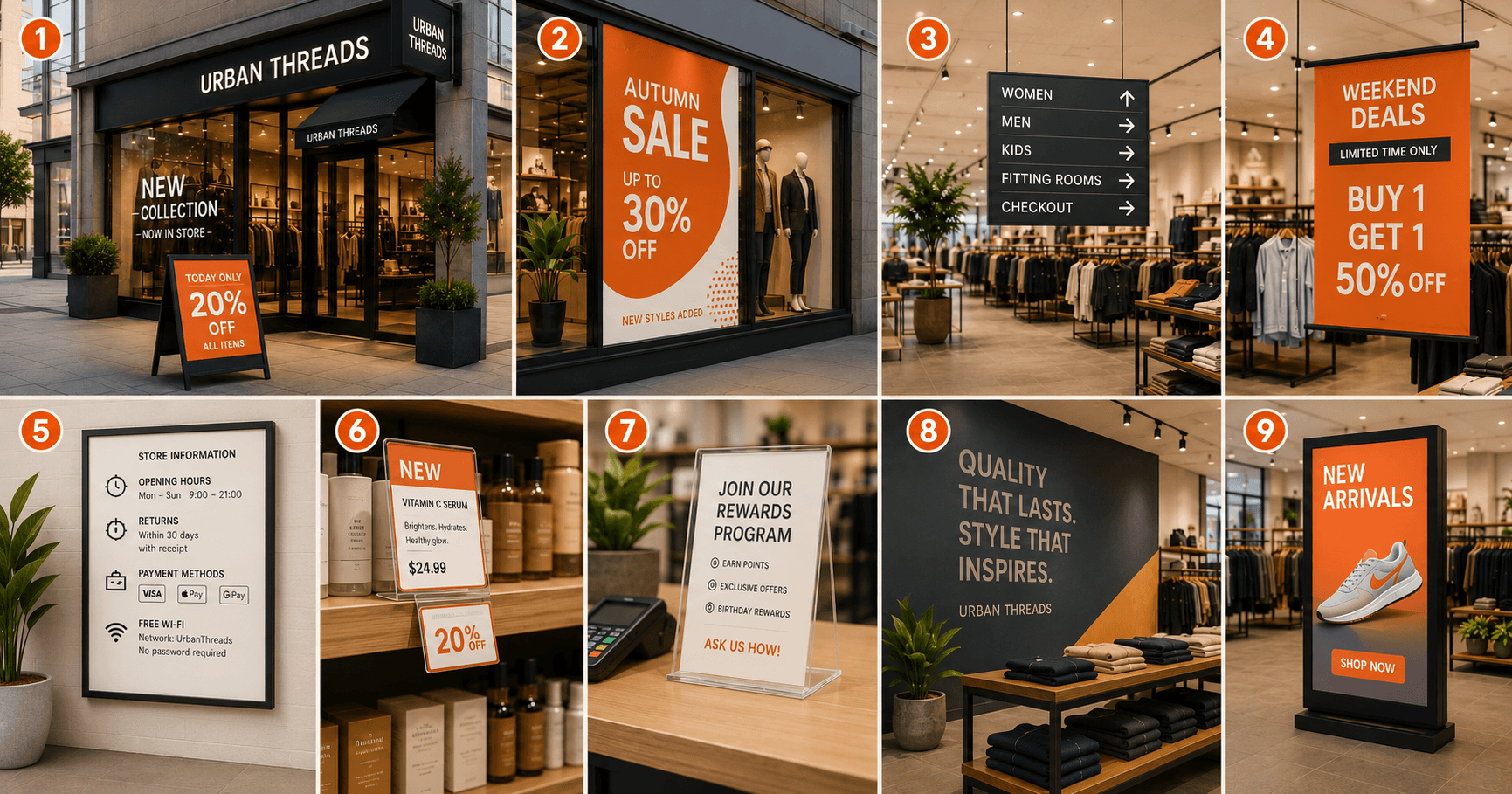
Retail stores use nine distinct types of signage, each built for a different moment in the customer journey. Here’s a full breakdown of each.
1. Exterior and storefront signage
Exterior signage covers everything a customer sees before they step inside, split across two distinct surfaces: the building itself and the space immediately around it.
Popular exterior retail formats:
Fascia or storefront signs, mounted above entrances to display the store name and logo
Projecting or blade signs, fixed perpendicular to the building so they are visible from down the street
Window vinyl graphics, carrying promotions, opening hours, or brand identity
A-boards (sandwich boards), placed on the pavement to advertise daily specials or draw passing attention
Awning signs, combining shelter and branding in a single structure
Lightbox signs, backlit displays that keep the storefront visible after dark
According to a Statista study cited by Verified Market Research, 61% of consumers are more likely to enter a store if they are attracted by dynamic exterior signage. For a high-street retailer with consistent footfall, that is a direct revenue variable.
Keep in mind: If your sign will be outdoors, choose materials that handle weather. Aluminum panels, UV-protected vinyl, and outdoor acrylic last significantly longer in rain and direct sun than standard print materials. For stores that stay busy in the evening, illuminated signs such as halo-lit letters keep your business visible after dark.
2. Window signage
Window signage occupies specific and valuable retail real estate: the glass itself. Unlike the fascia above, window displays can change frequently. They are the natural home for seasonal promotions, new arrivals, sale announcements, and brand storytelling that needs to rotate with the retail calendar.
Traditional window retail signage formats:
Vinyl decals and static clings, applied directly to the glass for promotions or brand graphics
Printed posters mounted behind the glass, in snap frames or poster holders
Frosted or perforated vinyl films, which allow branding on the glass while maintaining visibility into the store
Foam board sale posters, rigid printed signs placed inside windows to highlight discounts or limited-time offers such as “30% off everything this weekend”
Standing banners, placed just inside the window line to feature deals or seasonal campaigns
Keep in mind: Every message change in a printed window format requires physical production and replacement. This limits how quickly a retailer can respond to short-notice promotions or fast-moving inventory.
3. Wayfinding signage
Wayfinding signage tells customers where things are: overhead aisle markers, department headers, store maps, directional floor stickers, and signs pointing to fitting rooms, restrooms, checkouts, and service desks.
Customers who can find what they came for quickly are also more likely to browse beyond their original intent. A RetailNext Retail Vibe Check Report found that 47% of Gen Z shoppers cite difficulty finding products as a significant in-store frustration. Clear wayfinding is not a nice-to-have. It is a direct factor in whether customers stay, browse, and buy.
Popular interior wayfinding formats:
Aisle markers, hanging overhead or at aisle ends to identify product categories at a glance
Department headers, labeling major sections such as “Men’s Apparel” or “Home & Kitchen”
Store maps or directories, used in larger retail footprints to help customers plan their route
Category and subcategory signs at shelf or rack level, making browsing intuitive without requiring staff assistance
Floor decals, directing customers toward featured sections or promotional displays
Keep in mind: In larger stores, poor wayfinding costs sales. Customers who cannot locate a product are more likely to leave than to ask for help and they rarely come back to find it later.
4. Promotional and sale signage
Promotional signage exists to drive a transaction: announce a discount, create urgency around a limited offer, communicate a bundle deal, or draw attention to a clearance section.
The language matters as much as the placement. Signs that communicate urgency or scarcity (such as “one remaining,” “offer ends Sunday,” or “buy now”) consistently outperform generic “SALE” messaging because they give the customer a concrete reason to act rather than a vague invitation.
Common retail promotional formats:
Large hanging banners above sale racks or featured product areas
Vinyl banners, weather-resistant and high-impact, for window displays or entrance areas
Event signage, temporary signs used during in-store promotions such as “Free tasting today 3–5PM” or “Launch weekend specials”
Window-mounted sale graphics for campaign messaging visible from the street
Poster stands and easels near featured products or at aisle ends
Keep in mind: Promotional signage ages faster than any other type on this list. A printed “50% off” banner from last month is a liability the week after the promotion ends. For retailers running frequent or rotating campaigns, the cost of updating printed promotional signage adds up quickly in both print spend and staff time.
5. Informational signage
Informational signage communicates facts rather than promotions: store opening hours, return policies, payment methods accepted, Wi-Fi passwords, fitting room rules, and product care instructions.
This type rarely gets the attention that promotional or exterior signs receive, but it directly affects customer experience. Shoppers who can answer their own questions without finding a staff member move through the store more smoothly and leave with a better impression.
Popular informational signage formats:
Wall-mounted signs near entrances or service points for store policies and opening hours
Countertop cards at service desks or tills for payment methods and return policies
Poster frames near fitting rooms for occupancy rules or care instructions
Printed panels at customer service desks, covering returns, warranties, or product guidance
Keep in mind: Informational signage becomes an operational problem the moment details change (new payment systems, updated return windows, revised opening hours) and printed signs across multiple locations need replacing manually, one by one.
6. Point-of-purchase and shelf signage
Point-of-purchase (POP) signage covers all signs that influence a customer at the moment of product selection. This is where buying decisions actually happen.
Popular POP and shelf signage formats:
End-cap displays with bold headers spotlighting seasonal or promotional products at the end of an aisle, one of the highest-visibility positions in any store
Shelf talkers or shelf strips, calling out discounts, product features, or cross-sells right where customers are comparing options
Wobbler signs, small cards extending outward from the shelf edge to catch a browsing customer’s eye
Tent cards, small folded signs sitting on a shelf to mark discounted items or bundle offers, for example “Now $199, save $50”
Floor decals, placed where shoppers naturally look down, guiding them toward a display or promotion
Keep in mind: Effective POP signage is specific. A card explaining what a product does, what problem it solves, or why it is worth the price gives the customer a reason to buy. A generic “NEW” flag tells them almost nothing.
7. Countertop signage
Countertop signage includes anything placed at or near the checkout counter. This area gets less attention than it deserves, customers waiting at the till have few distractions and no competing surfaces pulling their eye. That makes the checkout counter one of the highest-receptivity spots in the store.
Popular countertop signage formats:
Acrylic countertop card holders, carrying promotional cards, loyalty program details, or return policy notices
Small poster frames, mounted at eye level near the till for campaign messaging or seasonal items
Product display units with integrated signage, combining the product and its promotional message in a single fixture
Tent cards, used for impulse-buy items or service add-ons such as extended warranties or gift wrapping
Keep in mind: A customer who has already decided to buy is the most receptive audience for an add-on offer. Signage at the checkout can promote loyalty program sign-ups, highlight impulse-buy items, communicate return policies, and feature products that complement what is already in the basket.
8. Branded retail signage
Branded signage covers everything designed to communicate identity, atmosphere, and values rather than drive an immediate transaction: large-format wall graphics, brand manifesto displays, lifestyle imagery, murals, illuminated brand panels, and in-store photography installations.
This type shapes how a customer feels about a brand while they are inside the store. It is the difference between a space that feels considered and one that feels purely functional. For fashion, beauty, lifestyle, and premium retail brands, environmental branding is how brand equity gets built at the point of experience.
Popular branded signage formats:
Full-wall vinyl prints, for large-scale campaign imagery or brand storytelling
Tension fabric graphic systems, backlit and frameless, used for high visual impact
Backlit brand panels, illuminated displays carrying logo, manifesto, or lifestyle content
Large-format photography displays, mounted at key focal points in the store
Keep in mind: The real challenge with branded retail signage is consistency across locations. When each store manages its own print production and installation, campaigns go up at different times, materials vary between sites, and brand standards slip. A flagship store looks one way; a regional branch looks another.
9. Digital signage
Digital signage in retail uses screen-based displays to show dynamic content inside or outside the store. It solves the core problems of static retail signage, the cost of reprints, the speed of manual changes, and the consistency gap between head office and local stores.
Retail digital signage is also the only type on this list that is not limited to a single function. One screen can serve as promotional signage, wayfinding, branded content, and countertop communication within a single playlist.
This is not just another sign type. It is the point where all the others converge.
The global retail digital signage market is projected to reach $21.2 billion by 2034, according to Market.us. Retail already accounts for over 21% of total digital signage installations worldwide, more than any other industry, according to Mordor Intelligence.
Common retail digital signage formats:
Video walls, used for high-impact window branding, entrance displays, or immersive in-store environments
Touchscreen kiosks, letting customers search product availability, compare specifications, and check stock in real time
Window-facing screens, running promotions and brand content for passersby around the clock
In-aisle and shelf-level screens, delivering product information or promotions at the point of consideration
Wayfinding displays, interactive directories and overhead screens that update in real time when layouts change
DOOH displays, screen-based advertising placed in high-footfall exterior locations such as storefronts, shopping mall corridors, and street-level windows
Social media walls, live feeds of branded social content or customer posts displayed in-store
Keep in mind: A practical concern for retailers evaluating digital signage is what happens when the connection drops. Yodeck stores content locally on the device’s SD card, so a network outage does not take screens offline. Content plays regardless of connection status, which matters in any store environment where downtime during trading hours is not acceptable.
> For practical content ideas across different store environments and screen placements, retail signage ideas and retail digital display use cases are good starting points.
Signage and the customer journey
Every sign in a retail store corresponds to a moment in the customer’s path from the street to the checkout. Understanding that map is what separates a signage strategy from a collection of signs.
| Customer journey stage | What the customer needs | Signage type that answers it |
|---|---|---|
| Awareness (outside the store) | To know the store exists and what it offers | Exterior and storefront signage, window signage |
| Entry (crossing the threshold) | To feel oriented and welcomed | Branded signage, wayfinding signage |
| Navigation (moving through the store) | To find what they came for without frustration | Wayfinding signage, informational signage |
| Consideration (browsing products) | To understand what products are and why they are worth buying | POP and shelf signage, promotional signage |
| Decision (at the point of selection) | A concrete reason to pick this product now | Promotional signage, POP signage |
| Purchase (at the checkout) | Confidence and optional add-ons | Countertop signage, informational signage |
| Loyalty (post-purchase) | A reason to return | Countertop signage (loyalty programs), branded signage |
Keep in mind: Digital signage is the only type that can adapt to each stage of this journey in real time.
When static retail signage stops working
For retailers with stable messaging, low promotional frequency, and a single location, printed signs are a functional and cost-effective choice. The problems appear when the retail environment starts moving faster than the signage can keep up, or when a multi-location brand needs to maintain consistency with HQ messaging across every store.
1. The cost-of-change problem
✗ Every time a promotion changes, a price updates, or a campaign ends, static signage costs money: design, print, delivery, and installation, multiplied by the number of locations, multiplied by the number of campaigns per year. A mid-sized chain with 20 locations updating promotional signage across eight campaigns a year is running a significant print operation alongside its marketing function.
✓ Digital signage eliminates the per-change cost. The hardware is a one-time investment. Every update after that costs nothing to produce and takes minutes to deploy.
2. The multi-location problem
✗ Managing signage manually across multiple stores is an operational risk, not just an inconvenience. Promotional content goes live at different times. Outdated sale signs stay up because no one has visited that location yet. Brand consistency slips because each store manages its own materials.
✓ A centralized digital signage platform means one update goes everywhere simultaneously. A flash sale launches at 9AM across all 20 locations and expires at midnight automatically.
3. The timing problem
✗ Static signage cannot change based on the time of day. A breakfast promotion displayed at 3PM, a winter campaign still running in spring, a sold-out product still featured on a shelf card, these are not edge cases. They are the normal output of a signage system that cannot adapt to time.
✓ Cloud-based scheduling solves this directly. A lunch promotion appears between 11AM and 2PM. A weekend sale activates on Friday morning and expires Sunday night. All configured once, running without manual intervention at each location.
4. The attention problem
✗ Static signs are visible when placed well. They do not move, update, or respond to what is happening in the store.
✓ Motion content captures more views than static prints in comparable positions. Personalized digital signage has been shown to increase dwell time by 40%, according to Mordor Intelligence. More time in-store means more opportunity to buy.
Static vs. digital retail signage: A side-by-side comparison
| Static signage | Digital signage | |
|---|---|---|
| Content updates | Requires reprint and physical replacement | Updated remotely in minutes from any device |
| Cost per update | Print cost and installation labor every time | No additional cost once hardware is installed and software activated |
| Attention capture | Visible when placed well | Captures more views than static prints |
| Multi-location management | Each location managed separately | All screens managed from one central dashboard |
| Promotion scheduling | Manual, requires advance production | Automated: content goes live and expires on a schedule |
| Content types | Images and text only | Video, animation, live data feeds, social content |
| Network dependency | None | Best platforms store content locally so outages do not interrupt playback |
| Environmental impact | Ongoing paper and print waste | One-time hardware, no recurring print materials |
| Upfront cost | Low | Moderate (hardware and software) |
| Long-term cost | Increases with each campaign update | Decreases as print costs are eliminated |
How to choose the right signage mix for your store
The right mix depends on store size, customer volume, and how often messaging changes.
How often does your promotional content change? If the answer is monthly or more, calculate the annual cost of reprinting and replacing static signage across all locations and compare it against the cost of digital hardware and software. For most mid-sized retailers running regular campaigns, digital pays back within 12 to 24 months.
How many locations do you manage? For multi-site operators, the case for centralized digital signage is operational as much as commercial. Consistent messaging, faster campaign rollouts, and no reliance on each store to manually update its own signs on schedule.
Where are the gaps in your customer journey? Map the path from the pavement to the checkout using the table above. At each stage, ask what a customer needs to know and whether your current signage answers that clearly. Gaps in the map are gaps in the strategy.
Where do you start? A store with no digital signage does not need to replace everything at once. A single entrance screen, a window-facing display, or a checkout monitor can each demonstrate measurable impact before a wider rollout.
Yodeck works with more than 6,000 retail companies, from single stores to networks of 500+ locations, and manages screens for 65,000+ businesses across 135+ countries. It has 8,100+ reviews across G2 and Capterra and was named one of G2’s 2026 Top 100 Highest Satisfaction Products. Sign up for free and test the platform before you scale.
Still reprinting your sale signs?
Try Yodeck’s award-winning digital signage solution. Update every screen from one dashboard.
Start for free