


Yodeck’s Screen Intelligence research explores what people actually want from the digital screens they encounter every day – and what the findings tell us about the future of digital signage.
Key Findings
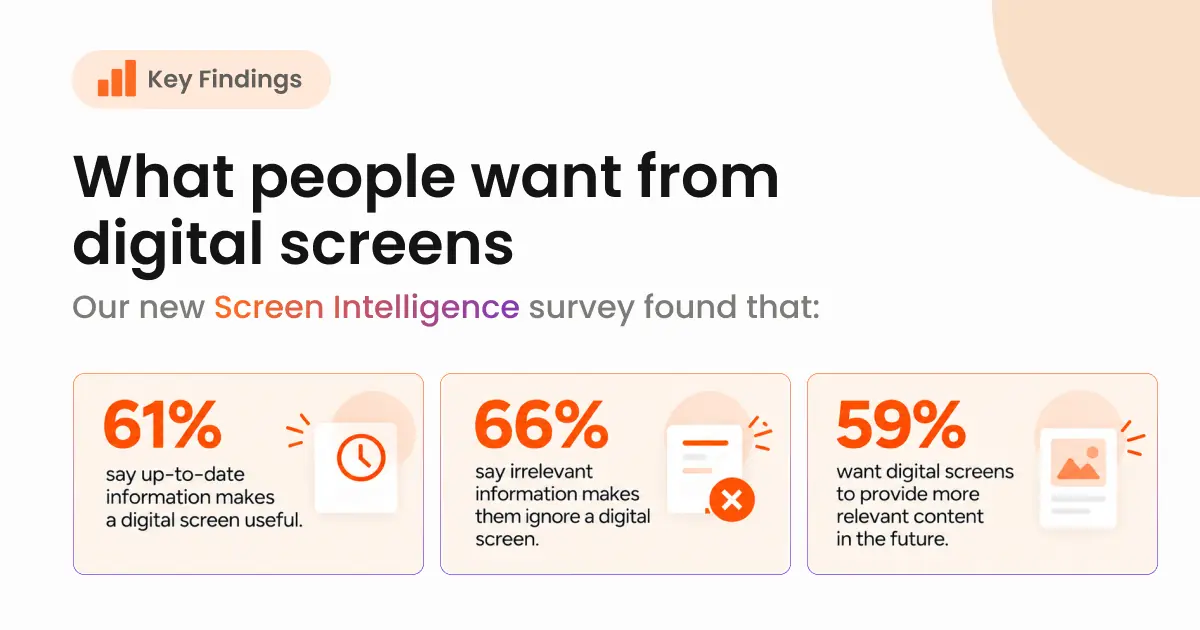
61% say up-to-date information makes a digital screen useful
66% say irrelevant information makes them ignore a digital screen
59% want digital screens to provide more relevant content in the future
Your flight has changed gates. You don’t want to download an app or ask someone where to go. You look up at the nearest screen and expect the answer to be there.
That’s a small moment, but it says a lot about what we expect from digital screens. We want them to tell us something useful at the moment it’s useful. And when they don’t, we stop paying attention.
Yodeck wanted to understand what that looks like from the audience’s point of view. So, in September 2026, we conducted an original survey asking people what makes digital screens useful, what makes them tune out, and what they want from them next.
What we found wasn’t a demand for screens packed with more technology. People were much more interested in whether the information on the screen was current, relevant and useful.
What makes digital signage content effective?
When we asked what makes a digital screen useful, 61% chose up-to-date information. Almost as many, 58%, chose information that’s relevant to them or the situation, while 52% said information needs to be clear and easy to understand. The answers about what makes people ignore screens followed the same pattern.
Irrelevant information topped the list at 66%. Too much information came next at 53%, followed by outdated content at 46%. Poor readability, content that isn’t useful and repetition were also common reasons to switch off.
A screen can be in exactly the right place, but if the content has little to do with the person looking at it, there’s not much reason to keep looking.
For businesses using digital signage – from workplaces and restaurants to retail digital signage – that’s a useful reminder. More content isn’t necessarily better content. Keeping information current and thinking about what an audience needs in that particular place can matter more than filling every available space.
Real-time digital signage stands out
Real-time updates were the most valued type of information in our survey, selected by 65% of respondents.
Menus and product information followed at 44%, then directions at 38% and announcements and alerts at 36%. Promotions, by comparison, were selected by 20%.
This is where real-time digital signage has an obvious advantage over static communication. The content doesn’t have to stay the same.
A restaurant can update its menu. A workplace can share an announcement when it matters. A store can change information throughout the day. A screen can respond to what’s happening around it rather than showing the same message regardless of context.
The benefits of real-time data are practical: information can change when circumstances do. For the teams managing those screens, the challenge is making those changes without creating more work. That’s where the platform behind the screen matters too.
The message for businesses is straightforward: audiences respond when content provides immediate value. Relevance, not simply visibility, is what transforms a screen into an effective communication channel.
The future of digital signage: What people want next
When we asked what digital screens should do better in the future, respondents didn’t put novelty at the top of the list.
More relevant content came first, at 59%. Real-time information followed at 54%, while 46% wanted improved clarity.
More engaging content was selected by 28%, ease of use by 23%, accessibility by 16%, and increased interactivity by 14%.
As the future of digital signage takes shape, there’s plenty of room for the technology to become more sophisticated. But these results are a useful check on what that progress should look like from the other side of the screen.
A new capability earns its place when it makes communication better.
Where does AI fit?
We didn’t ask people whether they were excited about AI. We asked what would matter most to them if technologies such as AI were used in digital screens.
The most common answer was making the information more useful, selected by 33% of respondents.
Another 17% said the technology itself doesn’t matter to them. Fourteen percent prioritized a more engaging experience and 13% more relevant information. Only 5% said the most important thing would be getting something they couldn’t do before.
People standing in front of a screen aren’t necessarily thinking about the technology behind it. They’re looking for a menu, a direction, an update, an announcement or something else they need.
That’s an important consideration as AI digital signage develops: the technology has to earn its place by improving the experience.
What makes a digital screen intelligent?
This brings us to a bigger question for our industry: what actually makes a screen intelligent?
At Yodeck, we don’t think intelligence is simply a matter of adding more features or putting AI behind a screen. We think about intelligence in terms of outcomes: what additional value does the technology create, and does it improve the experience for the audience? That’s at the heart of how Yodeck defines Intelligent Digital Signage.
The responses in this survey put that idea into practical terms. People want information that’s relevant to where they are. They want it to be current. They want to understand it quickly. And when new technology enters the picture, they want it to make the information more useful.
An intelligent screen doesn’t need to look futuristic. It needs to do its job well.
Turning those expectations into better screen experiences
Knowing what audiences want is one thing. Delivering it consistently across one screen, 100 screens or thousands is another.
Teams need to keep information current, adapt content for different contexts and make changes quickly without turning screen management into another full-time job.
That’s where Yodeck can help. Yodeck gives teams a central platform to create, schedule, manage and update digital signage content across their screen network, making it easier to keep communication timely and appropriate for different screens and audiences.
The research points to a future where better digital signage isn’t simply about putting more technology behind a screen. It’s about using technology to make what happens on the screen more useful to the person standing in front of it.
The most intelligent screen isn’t necessarily the one doing the most. It’s the one doing the most useful thing for the person looking at it.
Methodology
Yodeck conducted an original online survey of 222 US adults in September 2026. The survey explored how people experience digital screens in public and shared spaces, including what attracts their attention, what makes screens useful, the information they value and what they expect from digital screens in the future.
Make every screen more intelligent
Better digital signage starts with getting the right content on the right screen at the right time. Yodeck makes it simple to create, schedule and manage content across your screen network from one place.