


We walk past digital screens all the time. At the airport, one tells us where to find our gate. At a hospital, another points us toward the right department. In a supermarket, a screen promotes thais week’s offers. At a restaurant, it might show us what to order.
They’re all screens. But do we trust them equally? As you will see below, not even close.
For The Screen Trust Report 2026, Yodeck conducted an original survey of 133 people to understand how consumers actually feel about the information they see on digital screens in public places.
What we found is that trust has surprisingly little to do with the screen itself. It has much more to do with where that screen is, what it’s telling us, and whether the information feels useful, accurate, and up to date.
And in some environments, people place a remarkable amount of trust in what they see.
Digital signage trends in 2026: people are noticing screens
Digital signage might blend into the physical environment, but that doesn’t mean people aren’t seeing it.
Nearly 79% of respondents reported seeing digital screens in public places in the past 90 days.
Among those who went on to identify where they had noticed them, retail stores topped the list at 62%, followed by supermarkets at 58%, airports at 53%, and restaurants at 51%.
Hospitals and banks both reached 42%, while shopping malls followed at 39%. And this isn’t an occasional encounter.
Of the people who answered our question about frequency, 29% said they always notice digital screens, and another 34% said they notice them often. A further 33% said sometimes. Only 4% said rarely, and nobody selected never.
In other words, screens have become a familiar part of the places we move through every day. But being visible is one thing. Being believed is another.
So, which screens do people trust most?
This is where things get interesting.
We asked people how much they trusted information displayed on screens across ten different environments, from retail stores and restaurants to hospitals, airports, banks, and public transportation. Hospitals came out on top.
Around 77% of respondents rated information on healthcare digital signage screens as either “trustworthy” or “very trustworthy.”
Airports weren’t far behind, at roughly 68%. Banks also performed strongly, with about 60% rating their screens as trustworthy or very trustworthy.
Compare that with shopping malls, where only around 38% gave one of those two trust ratings. Almost 57% were neutral.
That gap tells us something important. A screen doesn’t automatically inherit trust just because it looks professional or happens to be digital.
Context gives the screen credibility.
In a hospital, an airport, or a bank, people expect the information they see to be operational, controlled, and important. A wrong gate number, incorrect hospital direction, or inaccurate banking message has consequences.
So people appear more willing to treat those screens as authoritative.
Put a similar screen in a shopping mall, and the assumption changes. Is it giving me useful information? Is it advertising something? Is it trying to sell to me?
Same technology. Very different relationship with the viewer.
What’s on the screen matters even more
Location was only half the story. When we asked respondents to rate different types of digital signage content, the gap became even clearer.
Safety information and emergency alerts were the most trusted content in the study.
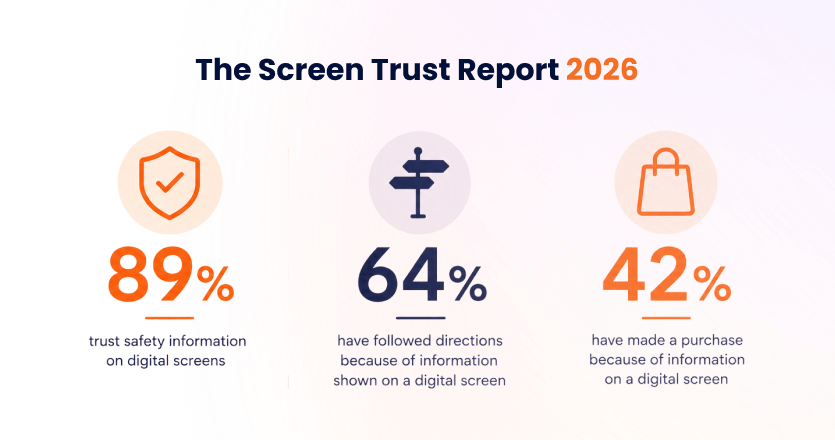
- About 89% rated safety information as trustworthy or very trustworthy.
- Emergency alerts received virtually the same level of trust.
- Directions were close behind at approximately 87%.
- Menus also performed well, with around 72% considering them trustworthy or very trustworthy.
Then we get to advertising. Only about 35% rated advertisements as trustworthy or very trustworthy. Roughly 42% were neutral, while almost 23% actively described them as untrustworthy or very untrustworthy.
That’s a big difference. And perhaps it shouldn’t surprise us.
When a screen says “Gate B42 →”, the viewer and the organization behind the screen want exactly the same thing: to get that person to Gate B42.
When a screen says “Buy this”, those interests aren’t necessarily as perfectly aligned. People seem to understand that distinction instinctively.
Think about the last time you were rushing through an unfamiliar airport. You might ignore a brightly designed ad without giving it a second thought. But when a departure screen tells you your flight has moved to Gate B42, you probably change direction immediately, often without stopping to verify it on another website first.
The pixels haven’t become more trustworthy. The purpose has. The information is specific to where you are, useful at that exact moment, and expected to come from an authoritative source. That combination of context, relevance, and immediacy is where digital signage becomes much more than a screen on a wall.
Accuracy beats aesthetics
One of the clearest findings in the report came when we asked a simple question:
What makes you trust information displayed on a digital screen?
- The number-one answer was accurate information, selected by 39% of respondents.
- Next came up-to-date content, at 21%.
By comparison, only 3% chose professional design and just 1% chose high-quality visuals.
That doesn’t mean design doesn’t matter. A confusing or poorly designed screen can absolutely make information harder to understand. But design alone can’t manufacture credibility.People want the screen to be right. And they want it to be right now.
For anyone managing a digital signage network, that distinction matters. A beautifully designed screen showing yesterday’s opening hours is still a bad screen.
And what destroys trust?
We asked the opposite question, too: what reduces your trust in a digital screen?
The most common answer was too many advertisements, selected by 25% of respondents. Next came two answers tied at 21%: outdated information and conflicting information.
Confusing layouts, poor design, missing sources, and excessive animation followed further behind. There’s an interesting tension here.
Advertising is one of the most obvious commercial uses of digital signage. But overload the screen with advertising and you risk weakening the very thing that makes the screen valuable in the first place: people’s willingness to pay attention to it and believe it. The takeaway isn’t “don’t advertise.” It’s earn trust before you spend it.
Give people useful information. Keep it current. Make it relevant to where they are. And don’t make every screen feel like it’s shouting for a sale.
Digital signage effectiveness: trusted screens drive action
Perhaps the most important finding in the report is that digital signage isn’t passive.
People act on what they see.
- 64% said they had followed directions because of information displayed on a digital screen.
- 42% had made a purchase. 35% had tried a product.
- Another 35% said a screen had helped them ask staff fewer questions, while 32% had entered a store or business because of something they saw.
- Only 7% selected “none of the above.”
That’s a significant reminder of what a screen can actually do.
The value of digital signage isn’t measured only in impressions or how many people walk past a display. A useful screen can remove friction.
It can help someone find their way through an unfamiliar building. It can answer a question before an employee needs to. It can introduce a product. It can bring somebody through the door. And yes, it can lead directly to a sale.
But when we’re unsure, humans still win
There was one result we particularly liked because it adds some necessary perspective.
We asked respondents which source they would trust first when visiting an unfamiliar place. The most popular answer wasn’t digital signage. It was a staff member at 59%.
Printed signs came next at 36%, with digital signage close behind at 33%. Company websites received 23%, while mobile apps came in at 13%. That doesn’t make digital signage less valuable. Quite the opposite, it shows where screens fit.
A good digital signage system doesn’t need to replace human interaction. It can handle the repetitive, immediate questions: “Where do I go? What’s available? How long is the wait? What do I need to know?”. While leaving staff free for the situations where people genuinely need another person.
And our respondents appear to be doing exactly that: 35% said digital screens had already helped them ask staff fewer questions.
Trust in digital screens isn’t declining
With more screens appearing in more places, we also wanted to know whether people had become more skeptical over time. The answer was largely no.
Almost half (49%) said their trust in digital screens had stayed about the same over the past five years. But 34% said it had increased slightly, and another 22% said it had increased significantly.
Only 11% reported any decrease in trust. So despite living in an environment where we’re exposed to more digital content than ever, consumers don’t appear to be turning against public screens.
If anything, many are becoming more comfortable relying on them.
What the findings mean for digital signage trends in 2026
Taken together, the results paint a strong picture for digital signage.
People are noticing screens, they are willing to trust them in the right context, and, most importantly, they act on the information they see. In our survey, 64% had followed directions shown on a digital screen, 42% had made a purchase, and 35% said screens had helped them ask staff fewer questions.
Trust also appears resilient. While 49% said their trust in digital screens had stayed about the same over the past five years, 56% said it had increased either slightly or significantly. Only 11% reported a decrease.
That is a positive signal for organizations investing in digital signage, but it comes with a qualification: a screen earns trust through the content it delivers.
The strongest results consistently appeared when digital signage was useful and purposeful. Directions, safety information, and emergency alerts earned particularly high trust. Accurate and up-to-date information was also the two leading factors respondents associated with trusting a screen.
So the opportunity for digital signage isn’t simply to put more screens in more places. It’s to make those screens genuinely useful: keeping information current, matching content to its environment, helping people make decisions, and avoiding the kind of advertising overload or conflicting information that can erode trust.
In that sense, the findings suggest that digital signage works best not as digital wallpaper, but as part of the experience itself.
What the Screen Trust Report tells us
The biggest lesson from this research isn’t that one type of screen is inherently more trustworthy than another. It’s that trust is earned through usefulness.
People trust hospital screens and airport screens because the information has a clear purpose. They trust directions, safety information, and emergency alerts because those messages help them do something they need to do.
They trust accurate, current information. And they’re much more skeptical when a screen becomes cluttered, outdated, contradictory, or overly promotional.
For businesses using digital signage, that’s a useful standard to keep in mind. Before asking, “What should we put on this screen?”, there may be a better question: “Why should someone trust what we’re putting on this screen?”
Get that right, and the screen becomes more than another display competing for attention. It becomes something people actually use. And, more importantly, something they believe.
Ready to put trusted, useful content on your screens? With Yodeck, you can create, manage, and update digital signage from anywhere, so the right information reaches the right screen at the right time.
About the research
The Screen Trust Report 2026 is an original survey conducted by Yodeck. The research surveyed 133 respondents about their exposure to digital signage, their trust in screens across different public environments and content types, and the actions they have taken after seeing information on a digital screen.