



New survey reveals what drives engagement
Key Findings
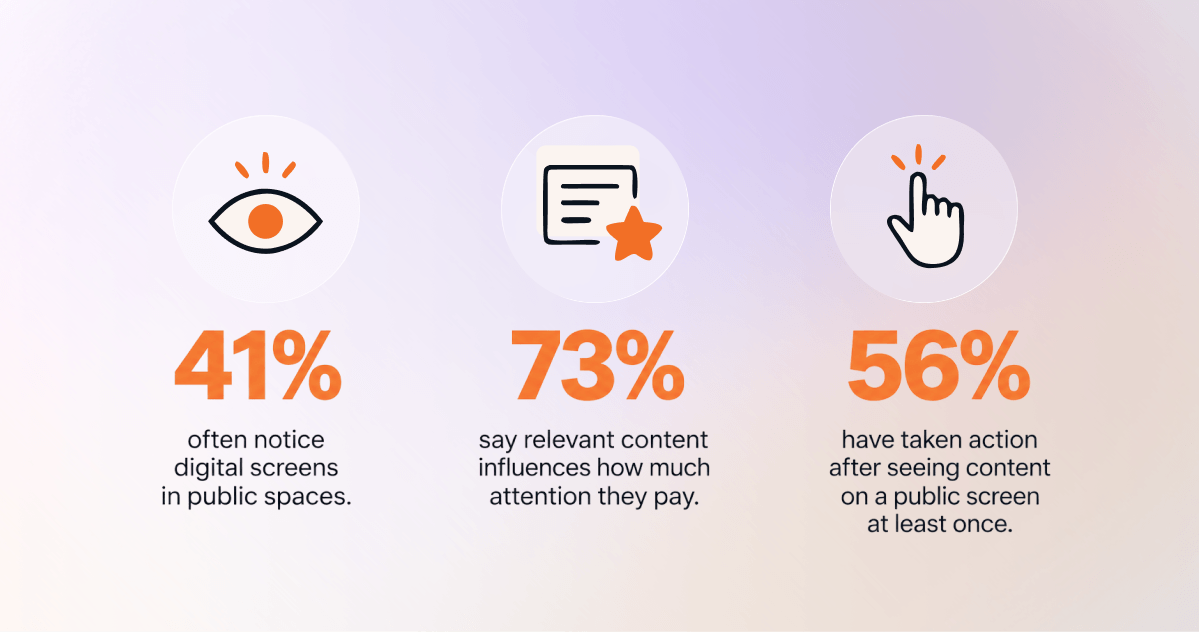
41% of respondents said they often notice digital screens in public spaces.
17% reported paying close attention to content displayed on public screens.
73% said relevance influences how much attention they pay to screen content.
56% have taken action after seeing content on a public screen at least once.
Offers and promotions ranked as the strongest attention-grabbers.
Think about the last time you saw a digital screen in a store, café, or restaurant. Did you glance at it and move on, or did something catch your eye? That’s exactly what we wanted to understand.
To explore digital signage viewer engagement, Yodeck surveyed 190 respondents about their interactions with digital screens in public spaces. The digital signage survey was conducted using SurveyMonkey on April 23, 2026.
The results provide new digital signage statistics on what captures people’s attention, the types of content they respond to, and whether screens can influence their actions. Consumers do notice digital signage, particularly when content is relevant to their needs. More importantly, many are willing to engage (and even take action) when screens deliver timely and useful information.
Public screens have become part of everyday life
The survey found that public venues such as stores, cafés, restaurants, and retail locations are a regular part of consumers’ routines, with nearly half of respondents visiting these spaces several times a week.
This frequent exposure creates valuable opportunities for businesses to connect with audiences where purchasing decisions and everyday choices happen.
In fact, 41% of respondents said they often notice digital screens in public spaces, highlighting the visibility that digital signage provides in high-traffic environments.
Do people pay attention to digital signage in stores? The survey suggests they do. Nearly half of respondents said they pay at least some attention to content displayed on public screens, while 17% reported paying close attention.
Attention is earned through relevance
Capturing attention has never been easy in a world of content, but the survey suggests that digital signage can be effective when its messages align with audience interests.
More importantly, the survey identified what drives engagement. Offers, promotions, and useful information ranked as the strongest attention-grabbers, followed by visually appealing and entertaining content.
What kind of content gets the most attention on screens? According to the survey, offers and promotions lead the way, with useful information also playing an important role in capturing attention.
The message for businesses is straightforward: audiences respond when content provides immediate value. Relevance, not simply visibility, is what transforms a screen into an effective communication channel.
Relevance should shape your digital signage content strategy
One of the clearest findings from the survey is the importance of content relevance.
Nearly three-quarters of respondents (73%) said that relevance influences how much attention they pay to information displayed on public screens.
How does relevance affect attention? The survey results show a clear connection: 73% of respondents said relevance affects how much attention they give to screen content. This suggests that messages aligned with audience needs, interests, location, or context have a stronger opportunity to capture attention.
This finding reinforces a growing reality across communication channels: consumers are increasingly selective about where they focus their attention. Content that is timely, useful, and aligned with audience needs is more likely to stand out.
For organizations developing a digital signage content strategy, this presents an opportunity to create more meaningful interactions by tailoring messages to specific audiences, locations, and moments.
How effective is digital signage at influencing decisions?
One of the most encouraging findings from the survey is that digital signage doesn’t just attract attention; it can inspire action.
More than half of respondents (56%) said they have taken action after seeing content on a public screen at least once.
Does digital signage influence purchase decisions? The survey shows that screen content can influence consumer behavior, with 56% of respondents reporting that they have taken some form of action after seeing content on a public screen. While not every action necessarily represents a purchase, the finding indicates that digital signage can play a role in moving audiences from attention to action.
Whether responding to a promotion, learning about a product, or acting on useful information, these interactions demonstrate the potential for digital signage to influence decisions in real-world environments.
Not surprisingly, clear offers and discounts were among the strongest motivators, highlighting the effectiveness of delivering actionable messages at the point where decisions are being made.
For businesses evaluating digital signage ROI, these findings highlight an important part of the equation: screens can do more than generate visibility. Relevant, actionable content can encourage behaviors that support broader business goals.
Digital signage creates opportunities where other channels can’t
Public screens offer a unique advantage: the ability to reach people in the exact places where decisions are being made.
Whether it’s a shopper considering a purchase, a customer browsing a menu, or a visitor navigating a space, digital signage can deliver relevant information at the moment it has the greatest potential to influence action.
The survey findings highlight the value of this opportunity. With 73% of respondents saying relevance influences their attention and 56% reporting that they have taken action after seeing screen content, businesses have a channel for connecting with audiences through timely, useful, and engaging messages.
Rather than replacing other forms of communication, digital signage extends the customer journey into the real world. It can reinforce messaging, support decision-making, and create meaningful interactions at the moments that matter most.
What this means for your digital signage content strategy
The findings point to a few practical principles businesses can apply to their screen content.
Lead with value. Offers, promotions, and useful information captured the most attention in the survey, suggesting that content should give viewers an immediate reason to look.
Prioritize relevance over visibility alone. Simply having a screen isn’t enough. With 73% of respondents saying relevance influences their attention, content should reflect the needs and context of the audience seeing it.
Time messages to the moment of decision. Digital signage has the advantage of reaching audiences in physical environments where choices are happening. Matching the message to the location and moment can make content more useful and actionable.
Together, these principles can help businesses build a digital signage content strategy focused not just on getting content onto screens, but on making that content worth noticing.
The opportunity ahead
The findings are clear: relevance drives attention, and attention can lead to action.
For businesses, that makes digital signage more than just a display channel. When used effectively, it becomes a powerful way to connect with audiences at the moments that matter most.
At Yodeck, we continue to explore the trends and behaviors shaping digital signage so businesses can make more informed decisions about their screen strategies.
Curious about how people interact with screens, content, and communication in everyday environments?
Explore more original surveys, industry research, and practical digital signage insights on the Yodeck blog.